
Understand B.Arch study, design studios, construction, climate, structures, history, professional practice and the built environment.
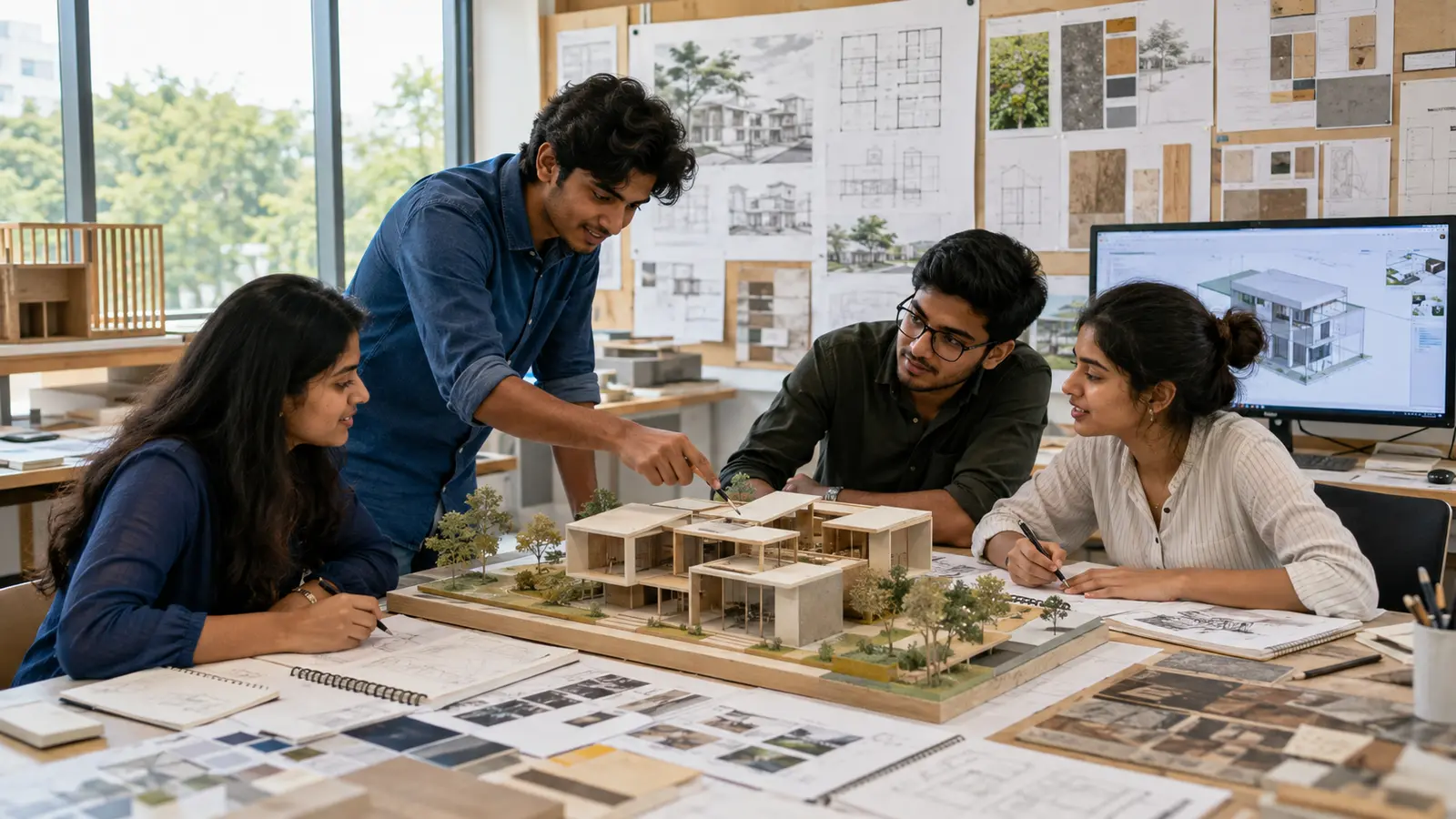
Understanding Architecture
Architecture is the study and practice of planning, designing and developing buildings and other parts of the built environment. It combines creativity, technical knowledge, social understanding, environmental responsibility and construction awareness to create spaces that are safe, functional, attractive and appropriate for their users.
Architecture students learn how people experience spaces and how buildings respond to climate, culture, materials, technology, regulations and the surrounding urban or natural environment. The course does not focus only on drawing attractive buildings. It requires students to understand construction, structures, building services, sustainability, professional practice, history, research and human behaviour.
Bachelor of Architecture, commonly called B.Arch, is the principal professional undergraduate architecture programme in India. It is generally a five-year, full-time course divided into ten semesters. The curriculum combines design studios, classroom subjects, workshops, site visits, case studies, professional training and a final architectural thesis.
Architecture is distinct from Architectural Engineering and Civil Engineering. Architects primarily work on spatial planning, design, form, functionality and coordination. Architectural engineers focus on the engineered systems of buildings, while civil engineers work on structures, infrastructure, construction and broader engineering systems.
Students who want professional registration as architects must understand that admission to an architecture course, completion of a recognised qualification and registration are related but separate stages. In India, the Council of Architecture maintains the register of architects and oversees recognised architectural education under the applicable legal framework. Candidates should verify the selected B.Arch programme for the relevant academic session and understand the registration process applicable after graduation.
Architecture Course Highlights
| Particular | Course details |
|---|---|
| Course name | Architecture |
| Principal undergraduate degree | Bachelor of Architecture |
| Common abbreviation | B.Arch |
| Course level | Undergraduate, postgraduate, diploma and doctoral |
| B.Arch duration | Five years |
| B.Arch structure | Ten semesters, including practical training and thesis |
| Common postgraduate degree | Master of Architecture |
| Undergraduate eligibility | Class 12 or eligible 10+3 diploma with the subjects and marks prescribed under current rules |
| Common entrance examinations | NATA, JEE Main Paper 2 and the applicable IIT architecture admission route |
| Major study areas | Architectural design, construction, structures, history, climatology, urban design and professional practice |
| Common career options | Architect, architectural designer, urban designer, BIM professional, conservation specialist and project coordinator |
| Suitable candidates | Students interested in design, buildings, people, drawing, technology and the environment |
| Important professional point | The programme and subsequent registration requirements should be verified from official sources |
Eligibility, entrance requirements, fees, programme recognition and admission processes can change. Candidates should use the current official notices of the institution, counselling authority and relevant architecture bodies.
What Is Architecture?
Architecture is the process of understanding human needs and converting them into built spaces. An architect may work on a house, school, hospital, office, hotel, museum, factory, transport terminal, public space or an entire urban district.
A successful architectural design must respond to many questions:
- Who will use the building?
- What activities will take place inside it?
- How should people enter, move and leave?
- What spaces require privacy?
- How will daylight and ventilation reach the interior?
- What materials suit the climate and budget?
- How will the structure support the proposed form?
- Where will electrical, plumbing and mechanical systems run?
- Is the building accessible?
- Can occupants evacuate safely during an emergency?
- How will the building affect the surrounding area?
- Can it be constructed and maintained efficiently?
Architects investigate these questions through sketches, drawings, physical models, digital models, calculations, discussions and iterative design. They coordinate with structural engineers, building-services engineers, contractors, landscape architects, planners, interior designers and clients.
Why Is Architecture an Interdisciplinary Field?
Architecture draws knowledge from multiple disciplines.
Art and design: Architects study composition, proportion, colour, texture, form and visual communication.
Engineering: Buildings require structural stability, safe services, durable materials and technically workable details.
Social sciences: Architecture responds to communities, culture, behaviour, identity and social needs.
Environmental science: Climate, energy, water, biodiversity and materials influence responsible design.
History: Historic buildings and settlements reveal how societies, technologies and design ideas have evolved.
Technology: Architects use CAD, BIM, visualisation, simulation, digital fabrication and project-collaboration tools.
Law and regulation: Projects must satisfy planning, building, accessibility, fire-safety and environmental requirements.
Economics and management: Design decisions affect project cost, construction time, maintenance and long-term value.
Students must therefore balance creativity with practicality. A visually impressive proposal that cannot be built safely or used comfortably is not a successful architectural solution.
Types of Architecture Courses
Architecture and the built environment include several qualifications.
Bachelor of Architecture: B.Arch is the main five-year professional undergraduate architecture degree. It includes design studios, building technology, history, services, structures, practical training and thesis.
Master of Architecture: M.Arch is generally a two-year postgraduate degree. It allows eligible graduates to specialise in areas such as urban design, conservation, sustainable architecture, landscape, housing or digital architecture.
Diploma in Architectural Assistantship: This diploma generally develops drafting, drawing, model-making, construction-documentation and basic design skills. It is not equivalent to B.Arch.
Bachelor of Planning: B.Plan focuses on settlement planning, land use, transport, infrastructure, policy and regional development. It is related to Architecture but has a different curriculum and career direction.
Bachelor of Design: B.Des may offer specialisations in interior, spatial, product, communication or industrial design. It is a design qualification and does not automatically replace B.Arch.
Interior-design programmes: These programmes focus on internal spaces, furniture, finishes, lighting and user experience. Their scope differs from that of Architecture.
Certificate courses: Short courses may teach AutoCAD, Revit, BIM, rendering, sustainable design, model-making or other skills. They supplement but do not replace a professional architecture degree.
Doctoral programmes: PhD programmes support advanced research in architecture, housing, heritage, urbanism, building science, technology and design education.
Major Architecture Specialisations
Architectural Design: Focuses on the conceptual and detailed development of buildings.
Urban Design: Examines streets, public spaces, neighbourhoods and relationships among groups of buildings.
Landscape Architecture: Deals with outdoor spaces, terrain, planting, water, ecology and public landscapes.
Sustainable Architecture: Concentrates on climate-responsive design, energy, water, materials and environmental performance.
Architectural Conservation: Studies the documentation, protection, repair and adaptive reuse of historic buildings and places.
Interior Architecture: Focuses on internal spatial organisation, materials, lighting, furniture and adaptive reuse.
Housing: Examines residential design, affordability, community needs and housing policy.
Industrial Architecture: Covers factories, warehouses, logistics facilities and technically specialised buildings.
Healthcare Architecture: Deals with hospitals, clinics, infection control, patient movement and clinical workflows.
Computational Design: Uses algorithms, parametric modelling, simulation and digital fabrication.
Building Information Modelling: Uses data-rich digital models for design, coordination, documentation and asset management.
Architectural Education and Research: Involves teaching, pedagogy, theory and scholarly investigation.
Difference Between Architecture and Architectural Engineering
| Architecture | Architectural Engineering |
|---|---|
| Focuses on spatial design, form, function and user experience | Focuses on technical building systems and performance |
| Primary professional UG degree is B.Arch | Common degrees include B.Tech, BE, BSc or BEng |
| B.Arch is generally five years | Undergraduate engineering course is commonly four years |
| Includes extensive design-studio work | Includes more engineering analysis and systems design |
| Leads towards the professional architecture pathway | Leads mainly towards engineering and technical roles |
| Covers building technology but emphasises integrated architectural design | Covers structures, HVAC, electrical, plumbing and building services in greater depth |
Students should not select a course solely because the names sound similar. They must compare the degree, curriculum and professional outcome.
Difference Between Architecture and Civil Engineering
Architecture focuses on designing spaces and coordinating the overall building concept. Civil Engineering is a broad engineering branch covering structures, roads, bridges, water systems, transportation, geotechnical engineering and construction.
Architects decide how a building should function and appear within its context. Civil and structural engineers determine how structural systems can safely carry loads. Both professionals collaborate, but their academic training and responsibilities differ.
Difference Between Architecture and Interior Design
Architecture addresses the complete building and its relationship with the site. Interior Design concentrates mainly on internal spaces, finishes, furniture, lighting and interior experience.
Architects may design interiors, but an Interior Design qualification does not automatically provide eligibility to practise as an architect.
Difference Between Architecture and Urban Planning
Architecture commonly addresses individual buildings or building groups. Urban Planning examines larger settlements, land use, transport, infrastructure, demographics, policy and development control.
Urban design occupies an intermediate scale, focusing on the physical form and experience of neighbourhoods, streets and public spaces.
Who Should Study Architecture?
Architecture may suit students who:
- enjoy observing buildings and public spaces;
- are interested in how people use space;
- combine creativity with practical thinking;
- are willing to draw, model and present ideas repeatedly;
- can accept criticism and revise their work;
- are curious about materials and construction;
- care about climate and sustainability;
- can manage long studio assignments;
- communicate effectively;
- enjoy history, culture and technology;
- can collaborate with different professionals; and
- are prepared for a demanding five-year course.
A student does not need to be an accomplished artist before joining. Observation, visual communication and design thinking can improve with training. However, willingness to practise drawing, modelling and presentation is important.
Reasons to Choose Architecture
Students may choose Architecture because it:
- combines creativity and technical knowledge;
- directly affects how people live, work and learn;
- offers opportunities in design, construction, research and urban development;
- allows specialisation in sustainability, conservation and technology;
- can lead to independent professional practice after meeting applicable requirements;
- provides a portfolio-based career;
- offers scope in India and abroad;
- supports entrepreneurship;
- allows work at scales ranging from furniture to cities; and
- contributes to social and environmental improvement.
Architecture should not be selected only because the student likes drawing. The course also requires research, writing, technical documentation, teamwork, deadlines and understanding of construction.
Architecture Academic Details
Continue your Architecture research
Course at a Glance
- Course AreaArchitecture, Planning and the Built Environment
- Study PathwaysB.Arch, M.Arch, diploma, certificate, planning, design and doctoral pathways
- Primary FocusArchitectural design, spatial planning, construction, structures, climate, history, representation, professional practice and the public realm.