
Understand programme levels, core subjects, practical learning, specialisations and career pathways.
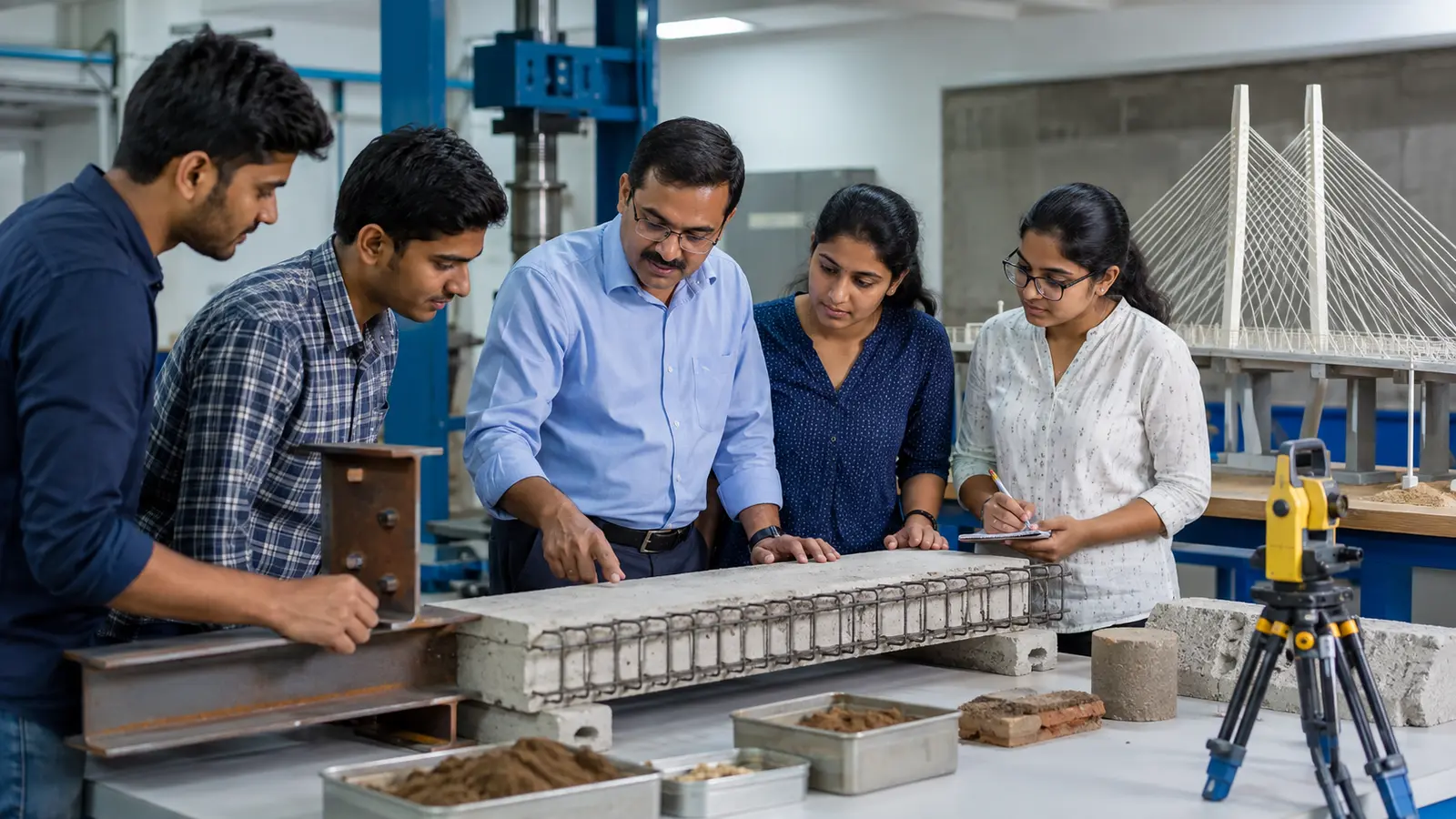
Understanding Civil Engineering
Civil Engineering creates and manages the built environment. Its work ranges from a small rural water system to a metro network or long-span bridge. Every project must respond to technical requirements, public safety, land conditions, weather, environmental impact, law, budget and the needs of users.
Civil Engineering frequently deals with unique projects constructed at a fixed location. Soil, climate, traffic, water, land use, community needs and local regulations differ from site to site. Civil engineers therefore combine established scientific and design principles with investigation, site-specific judgement and professional responsibility.
Civil Engineering course highlights
| Particular | General details |
|---|---|
| Course name | Civil Engineering |
| Common degrees | BTech Civil Engineering and BE Civil Engineering |
| Course levels | Diploma, undergraduate, postgraduate and doctoral |
| BTech/BE duration | Four years or eight semesters |
| Diploma duration | Usually three years |
| Lateral-entry duration | Usually three years after second-year entry |
| Basic UG eligibility | Class 12 with Physics and Mathematics plus an accepted third subject |
| Common entrance routes | JEE Advanced, JEE Main, state CETs and university tests |
| Core areas | Structures, soil, transportation, water, environment, surveying and construction |
| Practical components | Survey camps, laboratories, drawing, software, internships and projects |
| Main employment sectors | Construction, infrastructure, consulting, government, real estate and utilities |
| Common roles | Site engineer, structural engineer, planning engineer, quantity surveyor and civil engineer |
Structural Engineering
Structural Engineering studies how buildings, bridges, towers and other structures carry loads. Engineers analyse forces caused by self-weight, occupants, vehicles, wind, earthquakes, temperature and other actions.
They design reinforced concrete, steel, masonry, timber or composite systems according to applicable codes. Safety, serviceability, durability and economy must all be considered. Structural design is not simply making a member strong; it also controls deflection, cracking, vibration and long-term behaviour.
Geotechnical Engineering
Geotechnical Engineering deals with soil, rock and groundwater. Engineers investigate the ground, interpret tests and design foundations, retaining structures, slopes, embankments and underground works.
Ground conditions are often uncertain because investigation samples only a small part of the site. Geotechnical judgement must therefore consider variability and construction observations.
Transportation Engineering
Transportation Engineering plans and designs systems for moving people and goods. It includes roads, pavements, traffic, railways, airports, ports and public transport.
Engineers study travel demand, alignment, geometry, materials, capacity, safety and maintenance. A successful system should be safe, accessible, efficient and environmentally responsible.
Water Resources Engineering
Water Resources Engineering manages rivers, rainfall, reservoirs, irrigation, drainage, groundwater and floods. Engineers design dams, canals, spillways, pipelines, stormwater systems and hydraulic structures.
Climate variability and growing demand make water planning increasingly important. Technical design must be combined with environmental and social understanding.
Environmental Engineering
Environmental Engineering protects health and ecosystems through water treatment, wastewater treatment, solid-waste management, air-pollution control and environmental assessment.
Civil engineers design systems that provide safe water and sanitation. They also reduce pollution caused by infrastructure and construction.
Surveying and Geomatics
Surveying measures positions, levels, distances and boundaries. Traditional instruments, total stations, GNSS, drones, GIS and remote sensing help engineers map land and monitor projects.
Accurate surveying is required for planning, design, quantities, setting out and verification. Small coordinate errors can create expensive site problems.
Construction Engineering and Management
Construction Engineering deals with how designs are built. It covers methods, equipment, temporary works, planning, estimation, contracts, quality, safety and resources.
Civil engineers coordinate drawings, materials, labour, subcontractors, approvals and inspections. Management knowledge becomes more important as projects grow in scale and complexity.
Building construction
Building projects involve foundations, frames, walls, roofs, finishes and services. Civil engineers may work in design, site execution, quality, planning or cost.
They coordinate with architects, electrical engineers, mechanical engineers and other specialists. A building's performance depends on these systems working together.
Bridges
Bridge Engineering covers site selection, loads, structural systems, foundations, bearings, joints, construction and maintenance. Bridges must withstand traffic, wind, water, temperature and sometimes earthquakes.
Inspection is essential because ageing, corrosion, fatigue and scour can reduce capacity over time.
Roads and highways
Highway Engineering includes route planning, geometric design, pavement materials, drainage, traffic and maintenance. Engineers design flexible and rigid pavements according to traffic, climate and subgrade conditions.
A road is more than its surface. Earthwork, drainage, safety barriers, signs, intersections and maintenance determine long-term performance.
Railways and metros
Railway Engineering addresses alignment, track, stations, structures and operations interfaces. Metro systems combine tunnels, elevated viaducts, stations, utilities and urban constraints.
Large rail projects require careful geotechnical, structural, environmental and construction coordination.
Airports
Airport Engineering includes runway geometry, pavement, drainage, terminal access and airside planning. Safety and international operating standards strongly influence design.
Dams and irrigation
Dams store and control water for irrigation, power, supply and flood management. Engineers study hydrology, geology, structures, spillways and downstream impacts.
Dam safety requires monitoring, maintenance and emergency planning throughout the asset's life.
Urban infrastructure
Cities need water, sewerage, storm drainage, roads, transit, housing and public spaces. Civil engineers plan networks and coordinate construction in crowded environments.
Urban projects must address existing utilities, traffic, land, accessibility and community disruption.
Rural infrastructure
Rural roads, irrigation, water supply, sanitation, schools and health facilities require context-appropriate engineering. Solutions should be maintainable, affordable and resilient.
Construction materials
Civil Engineering uses concrete, steel, masonry, timber, asphalt, soil, aggregates and composites. Engineers study strength, durability, availability, cost and environmental impact.
Material quality can vary. Sampling, testing and proper workmanship are necessary for reliable construction.
Concrete
Concrete combines cement, water, aggregates and often admixtures. Its performance depends on proportioning, mixing, transport, placement, compaction and curing.
High compressive strength alone does not guarantee durability. Permeability, cracking, exposure and workmanship are also important.
Steel
Structural steel provides high strength and speed of construction. Engineers design members, connections and stability systems. Corrosion protection, fire behaviour and fabrication quality require attention.
Soil as a construction material
Soil supports structures and is also used in embankments, roads, dams and fills. Moisture, density, grain size and compaction influence performance.
Civil Engineering design codes
Codes provide standard rules for loads, materials, analysis, detailing and safety. Engineers must use the current applicable code and understand its scope.
Following a code does not replace professional judgement. Unusual structures or conditions may require specialist analysis.
Infrastructure life cycle
Civil work begins with need identification, feasibility and survey. It proceeds through planning, design, approvals, procurement and construction. Operation, inspection, maintenance, repair and eventual replacement follow.
Life-cycle thinking helps owners avoid choosing the lowest initial cost when it creates high maintenance or failure risk.
Public safety
Civil-engineering decisions affect large numbers of people. A design or construction failure can cause serious loss. Engineers must work within competence, check calculations, report unsafe conditions and maintain accurate records.
Sustainability
Infrastructure consumes materials, land, water and energy. Sustainable Civil Engineering reduces embodied carbon, protects ecosystems, manages waste and designs for durability and adaptation.
Claims should be measured through quantities and life-cycle effects. A single green material does not automatically make an entire project sustainable.
Climate resilience
Floods, heat, storms, sea-level change and water scarcity affect infrastructure. Engineers use updated hazard information, robust drainage, resilient materials and emergency planning.
Historical conditions may no longer be sufficient for future design. Uncertainty must be acknowledged.
Digital Civil Engineering
Digital tools include computer-aided design, structural analysis, GIS, BIM, drones, sensors, digital twins and project dashboards. They improve coordination and data use.
Software is only as reliable as its inputs and assumptions. Engineers must check models and understand physical behaviour.
Building Information Modelling
BIM creates organised digital information about an asset. Civil engineers use it for coordination, quantities, scheduling, construction and facility management.
BIM is not merely 3D drawing. It requires information standards, responsibilities and collaborative workflows.
Who should choose Civil Engineering?
The course may suit students who enjoy Mathematics, Physics, drawing, problem-solving and the built environment. They should be willing to visit sites and understand real construction conditions.
Patience, responsibility and communication are important. Civil projects can take years and involve many stakeholders.
Advantages of the course
Civil Engineering serves essential public needs and offers diverse specialisations. Graduates can work in design, construction, government, consulting, environment, water, transportation and management.
The skills remain useful as infrastructure evolves. Roads, water systems and buildings require continuing maintenance and improvement.
Limitations students should understand
Entry-level site jobs may involve long hours, travel, outdoor conditions and relocation. Starting salaries can be moderate in small contractors. Senior design roles require experience and often postgraduate specialisation.
The branch has a large graduate population, so practical skills and a focused profile are important.
Is Civil Engineering a good course?
It can be an excellent course for students interested in infrastructure and public service. Career success depends on technical competence, software, site exposure, communication and professional integrity.
Continue your Civil Engineering research
Course at a Glance
- Course AreaCivil and Infrastructure Engineering
- Study PathwaysDiploma, B.E./B.Tech, M.E./M.Tech, certificates and doctoral study
- Primary FocusStructures, concrete, soil mechanics, surveying, transport, hydraulics, environment, construction and infrastructure design.