
Understand programme levels, core subjects, practical learning, specialisations and career pathways.
Understanding Electrical Engineering
Electrical Engineering connects energy sources with the equipment that uses electricity. A generating station produces power, transformers change voltage, transmission lines carry bulk energy and distribution equipment supplies consumers. Protection, measurement and control keep this connected system reliable.
Electrical circuits
Circuit theory explains voltage, current, resistance, capacitance, inductance, power and energy in direct- and alternating-current networks. It is the language used to analyse machines, electronics, power systems and control hardware.
Electrical machines
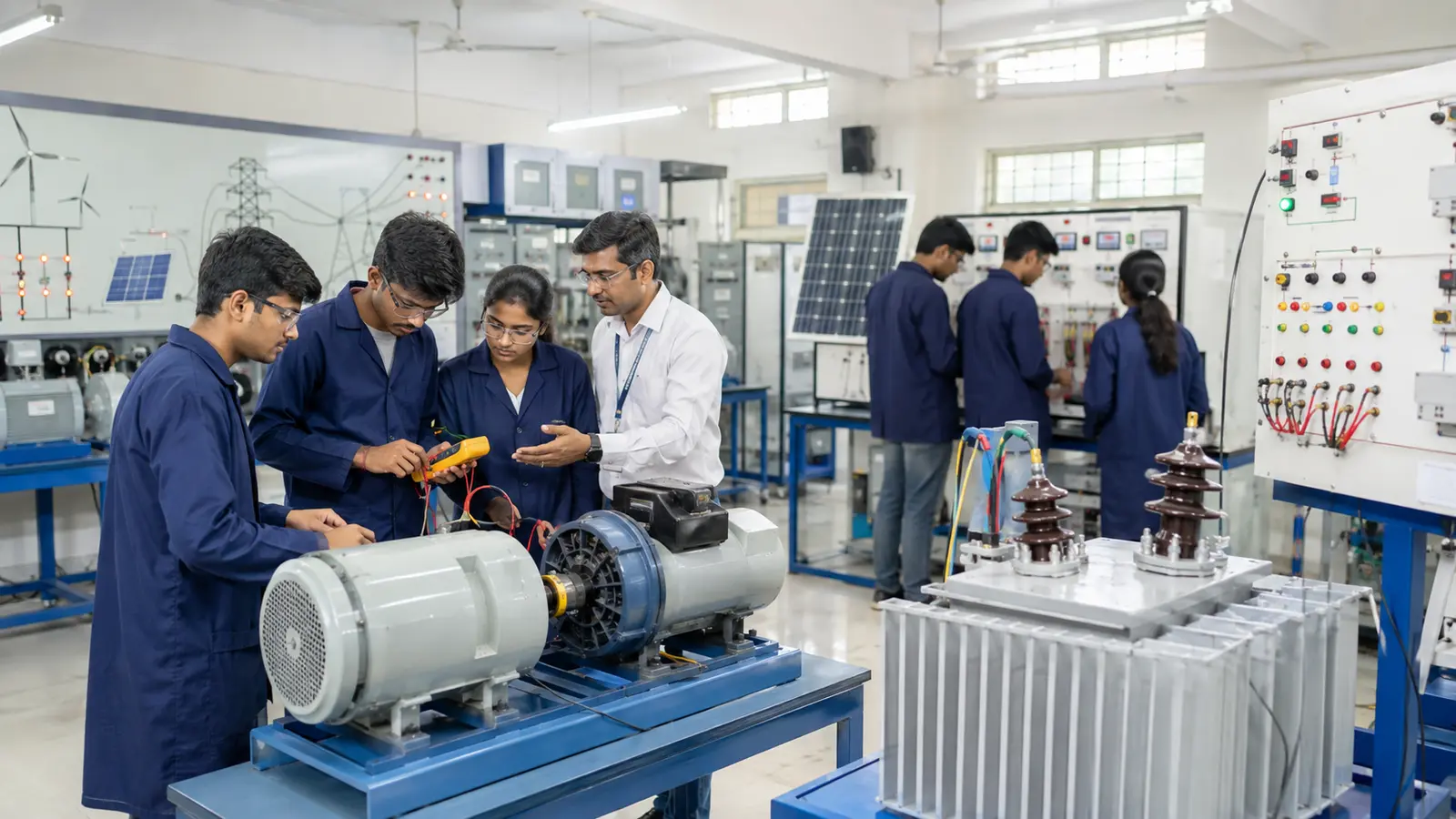
Electrical Machines covers transformers, direct-current machines, induction motors and synchronous machines. Students learn operating principles, characteristics, starting, speed control, losses, efficiency, testing and applications.
Main parts of an electrical energy system
| Element | Main purpose |
|---|---|
| Generation | Produces electrical energy from thermal, hydro, nuclear, solar, wind or other sources |
| Transformation | Changes voltage levels for efficient transfer and safe utilisation |
| Transmission | Carries bulk power over long distances |
| Distribution | Delivers electricity to industrial, commercial and domestic consumers |
| Protection | Detects abnormal conditions and isolates faulty equipment |
| Power conversion | Changes voltage, frequency or current form using electronic converters |
| Measurement and control | Monitors variables and regulates system behaviour |
| Load | Converts electrical energy into motion, heat, light, computation or another useful form |
Power systems
Power Systems studies generation, transmission and distribution networks. Important topics include per-unit calculations, load flow, faults, stability, protection, economic operation, power quality and grid integration of renewable sources.
The subject combines physical equipment with network analysis and operational decisions. Engineers must consider safety, reliability, voltage, frequency, losses, cost and the effect of a disturbance on connected users.
Electronics
Electronics introduces diodes, transistors, amplifiers, operational amplifiers, digital logic and semiconductor applications. The depth is generally lower than in a dedicated Electronics programme, but it is sufficient to understand measurement, control, conversion and embedded hardware.
Power electronics
Power Electronics uses semiconductor switches to convert and control electrical energy. Rectifiers, choppers, inverters and AC controllers support motor drives, renewable-energy systems, battery charging, electric vehicles and efficient power supplies.
Control systems
Control Systems uses modelling, feedback and controllers to regulate voltage, speed, position, temperature and other variables. Students learn time and frequency response, stability, PID control, state-space methods and digital implementation.
Measurements and instrumentation
Measurements subjects cover instruments, sensors, bridges, transducers, errors, calibration and data acquisition. Reliable measurement is necessary for testing equipment, billing energy, protection and automated control.
Industrial automation
Industrial automation integrates sensors, programmable controllers, motor drives, robots, supervisory systems and industrial communication. Electrical graduates can contribute when they combine electrical safety, machines, control and programming.
Programme levels in India
| Level | Common route | Typical purpose |
|---|---|---|
| Diploma | Diploma in Electrical Engineering | Technician-level practical foundation and route to work or further study |
| Undergraduate | BE/BTech Electrical Engineering | Broad education in power, machines, electronics, control and computing |
| Postgraduate | ME/MTech Power Systems, Power Electronics, Control, Drives, High Voltage or related area | Advanced specialisation and research preparation |
| Doctoral | PhD in an electrical or electronics field | Original research and advanced academic or R&D work |
| Certificate | Electrical safety, PLC, solar, drives, protection or platform course | Focused development; not a replacement for a recognised qualification |
Applications
Electrical Engineering is applied in power plants, substations, grids, solar and wind projects, electric mobility, rail traction, factories, data centres and building services. Every application has different voltage, safety, reliability and regulatory requirements.
Who should choose this field?
The field suits students who enjoy Mathematics, Physics, circuits and practical problem-solving. They should be comfortable working with both physical equipment and analytical models. Programming and electronics are increasingly important, but electrical safety and fundamentals remain central.
Students need patience because laboratory circuits fail, machines behave differently under load and measurement errors can hide the real cause of a problem. Electrical work also demands strict safety discipline because incorrect practice can cause shock, fire or equipment damage.
Electrical Engineering and EEE
The titles overlap substantially. Electrical Engineering often gives greater weight to power, machines, protection and high voltage, while EEE may give additional space to electronics and embedded subjects. The actual syllabus is more important than the label.
Electrical Engineering and Electronics and Communication Engineering
Electronics and Communication Engineering generally concentrates more on communication, signal processing, microelectronics and electronic systems. Electrical Engineering normally includes much more power systems, machines, protection and high-voltage content. Both may include circuits and control.
Continue your Electrical Engineering research
Course at a Glance
- Course AreaElectrical and Electronics Engineering
- Study PathwaysDiploma, B.E./B.Tech, M.E./M.Tech, certificates and doctoral study
- Primary FocusPower systems, electrical machines, protection, control, high voltage, power electronics, renewables and energy management.