
Understand programme levels, core subjects, practical learning, specialisations and career pathways.
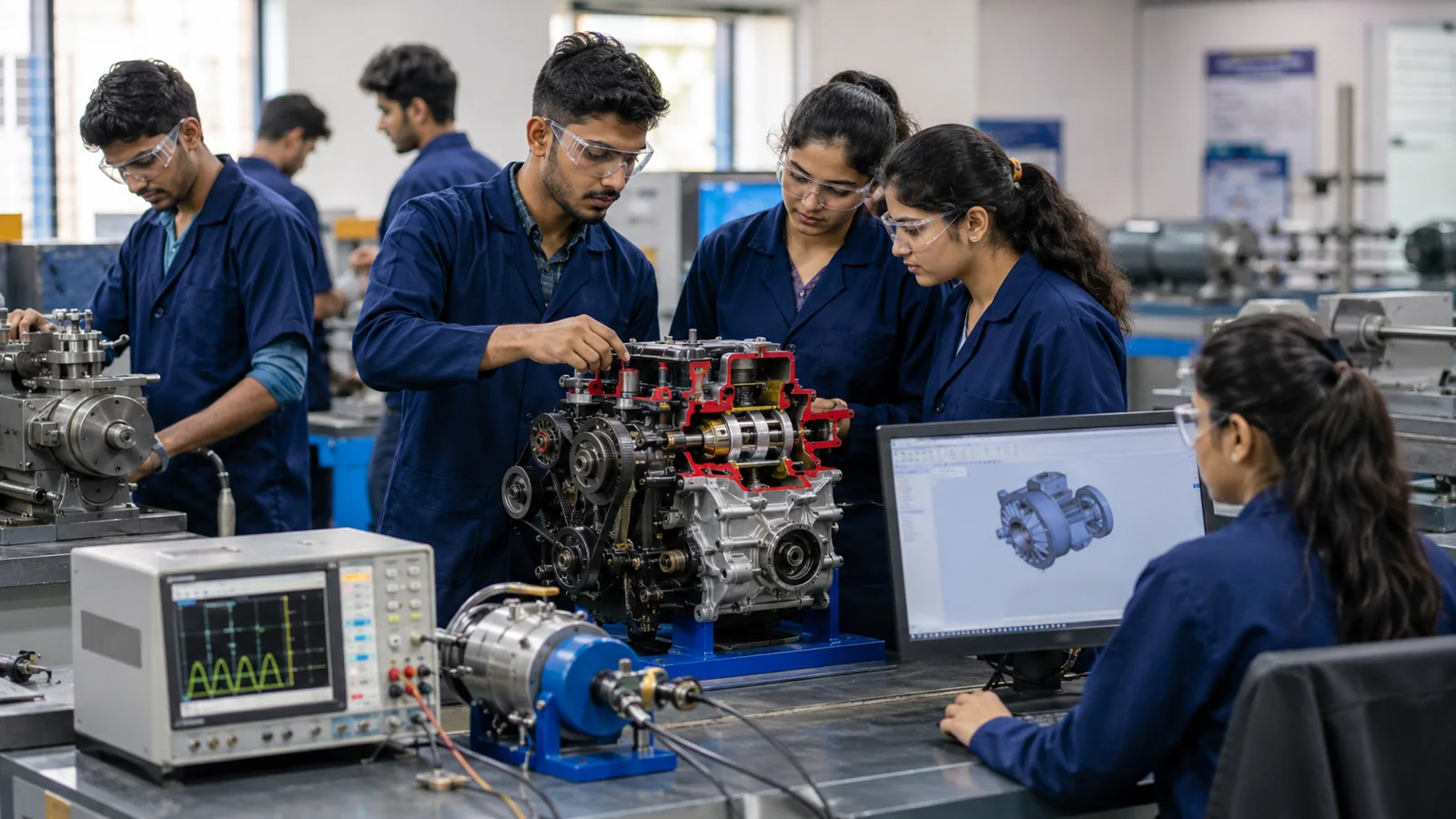
Understanding Mechanical Engineering
Mechanical Engineering begins with a need: moving a load, producing power, controlling temperature, transporting people or making a reliable product. Engineers convert that need into requirements, calculations, models, drawings, prototypes and tests. They evaluate safety, performance, manufacturability, cost, energy use and maintenance across the system lifecycle.
In India, students can pursue a diploma, BE/BTech, ME/MTech or PhD. Postgraduate specialisations include Machine Design, Thermal Engineering, Fluids, Manufacturing, Industrial Engineering, Automobile Engineering, Robotics, Energy and Computational Mechanics.
Course highlights
| Particular | Typical information |
|---|---|
| Main UG awards | BE/BTech Mechanical Engineering |
| Related UG titles | Automobile, Production, Manufacturing, Mechatronics and Aerospace Engineering |
| UG duration | Four years |
| Main PG awards | ME/MTech Mechanical Engineering or Technology |
| PG duration | Two years |
| UG eligibility | Class 12 with Physics and Mathematics plus an approved subject |
| UG entrance | JEE Main, VITEEE, BITSAT, state tests or university admission |
| PG admission | GATE, CCMT, CEETA/TANCET, university test or merit |
| Core areas | Mechanics, machine design, thermodynamics, fluids, materials and manufacturing |
| Major sectors | Automotive, aerospace, machinery, electronics, defence, energy and medical products |
Mechanical system
A mechanical system may include structures, mechanisms, motors, engines, pumps, turbines, bearings, controls and thermal equipment. Engineers establish loads, operating conditions, interfaces and failure limits before selecting materials and dimensions.
Good design considers the whole system. A powerful motor cannot correct an undersized shaft, poor lubrication, unstable control or unsafe guarding. Engineers therefore balance performance, reliability, cost, maintenance and environmental impact.
Mechanical Engineering versus Manufacturing Engineering
Mechanical Engineering covers design, thermal systems, fluids, machines and manufacturing. Manufacturing Engineering concentrates more deeply on production processes, tooling, automation, quality and factory systems. Mechanical graduates can enter manufacturing roles when they build the required process knowledge.
Mechanical Engineering versus Production Engineering
The terms overlap substantially. Production Engineering traditionally combines manufacturing processes with planning, control and industrial management. Mechanical Engineering may give greater attention to process technology, automation, CAD/CAM and materials.
Actual syllabus matters more than the title. Students should compare core mechanical subjects, laboratories, quality, automation and management content.
Mechanical Engineering versus Industrial Engineering
Industrial Engineering focuses on systems, productivity, operations research, ergonomics, supply chain, quality and management across many sectors. Mechanical Engineering includes these ideas but has deeper machine, process, tooling and material content.
Mechanical Engineering versus Advanced Manufacturing
Advanced Manufacturing refers to newer tools such as additive manufacturing, robotics, digital twins, connected factories and data-driven control. Mechanical Engineering includes both conventional and advanced processes. Strong fundamentals are required before applying new technology.
Mechanical Engineering versus Mechatronics
Mechatronics integrates mechanical, electronics, control and software for intelligent machines. Manufacturing engineers use mechatronic systems but focus on production processes, tooling, quality and factory performance.
Programme levels
Diploma: Three-year Mechanical, Production, Tool and Die or Manufacturing diplomas can prepare technicians and support lateral entry.
BE/BTech: Four-year degree combining general engineering, manufacturing processes, design, automation, quality and projects.
MTech: Two-year specialisation for advanced manufacturing, automation, materials, optimisation or research.
PhD: Research areas include machining, forming, additive processes, metrology, robotics, sustainable manufacturing and digital systems.
Mechanical engineering lifecycle
The lifecycle begins with requirements and concept selection. Engineers calculate loads, energy, heat transfer and flow; create digital models; select materials; build prototypes; and validate performance through tests.
During service, maintenance and condition monitoring preserve reliability. Failure evidence supports design improvement. End-of-life planning considers repair, remanufacture, recycling and safe disposal.
Design for manufacturability and assembly
Design for manufacturability examines whether a component can be produced with available processes, tolerances, tools and inspection. Engineers review material, geometry, wall thickness, corner radii, machining access, draft angles, joining and standard sizes before drawings are released.
An unnecessarily tight tolerance increases machining and inspection cost and can reduce yield. A tolerance should reflect function, assembly and measurement capability. Manufacturing engineers provide evidence to designers rather than simply widening limits.
Design for assembly reduces difficult orientation, unnecessary fasteners and inaccessible joints. Mistake-proof features can prevent incorrect installation. Fewer parts may reduce cost, but combining parts can make repair or recycling harder.
Early collaboration is more effective than asking production to solve every issue after tooling is purchased. Prototype feedback, process simulation and supplier input should be incorporated through controlled design changes.
Process selection
Process selection compares material, shape, size, tolerance, surface, quantity, rate, capital and lead time. Casting may create complex near-net shapes, forging can improve directional properties, machining provides accuracy and additive methods can create difficult geometry.
No process is automatically superior. A simple machined part may be cheaper and more reliable than an additively manufactured version. High-volume production can justify dedicated dies or automation that would be uneconomic for prototypes.
Engineers often use a process chain. A part may be cast, heat-treated, machined, coated and inspected. The chain should preserve datum logic and detect defects before expensive later operations.
Production launch and industrialisation
Industrialisation converts a prototype into controlled production. Teams finalise drawings, bills of material, process flow, equipment, tooling, inspection, packaging, work instructions and supplier plans.
Pilot runs reveal issues with cycle time, access, variation, operator workload and material handling. Engineers record problems and repeat trials until readiness criteria are met. Shipping a few hand-adjusted parts does not prove production capability.
Training should explain why critical steps matter, not only list motions. Operators often identify practical risks that office planning misses. Their input improves work instructions and ergonomics.
Types of manufacturing
Job production handles customised, low-volume products. Batch production makes defined quantities, while mass and continuous production support high volume. Flexible manufacturing attempts to handle variety with controlled changeover.
Discrete manufacturing produces countable parts and assemblies. Process manufacturing transforms bulk materials. Mechanical Engineering commonly focuses on discrete systems but shares principles with process industries.
Major applications
Automotive plants use casting, forging, machining, welding, painting and assembly. Aerospace requires traceability, precision and strict qualification. Electronics needs clean, automated and high-speed processes.
Medical and energy products require material and regulatory control. Small and medium manufacturers need practical improvements in tooling, layout, maintenance and quality as much as large automated plants.
Who should choose the course
The branch suits students interested in machines, materials, design and problem-solving. They should enjoy workshops, measurements, drawings, data and practical experiments.
Manufacturing work may involve plants, shifts, noise, heat and safety procedures. Students seeking only desk-based software work should understand these conditions before admission.
Benefits and limitations
The course provides broad industrial relevance and visible connection between design and product. Skills in quality, automation and process improvement transfer across sectors.
The exact undergraduate title is offered at fewer colleges than Mechanical Engineering. Employment can be cyclical and plant locations may be outside city centres. Senior careers require continued learning and responsibility for safety and people.
Continue your Mechanical Engineering research
Course at a Glance
- Course AreaMechanical and Mechanical Engineering
- Study PathwaysDiploma, B.E./B.Tech, M.E./M.Tech, certificates and doctoral study
- Primary FocusStudy Mechanical Engineering eligibility, syllabus, fees, entrance exams, colleges, practical skills and career scope in India.