
Understand programme types, vehicle systems, chassis, dynamics, powertrains, electronics, EVs, manufacturing, testing and mobility careers.
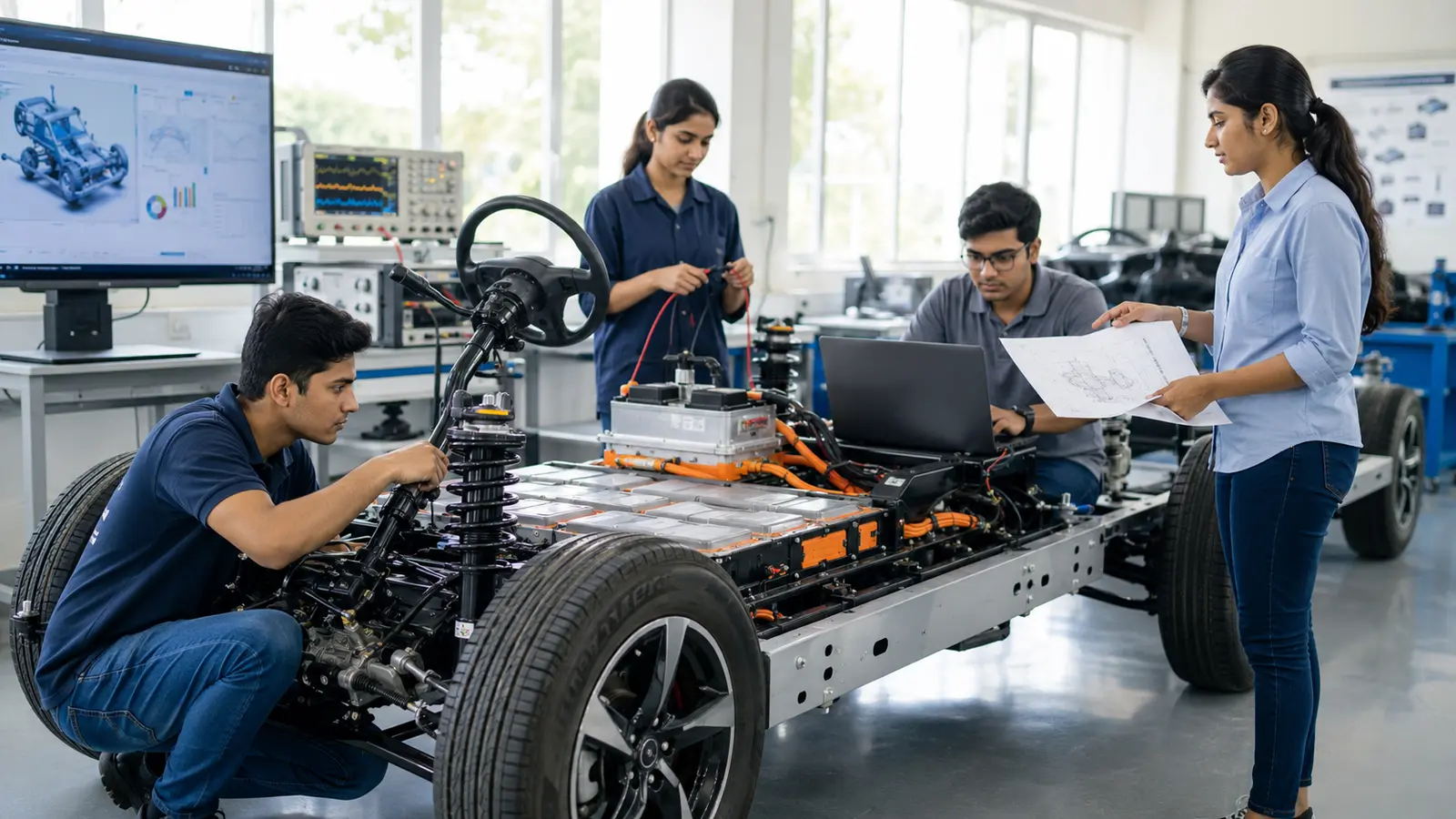
Understanding Automobile Engineering
Automobile Engineering focuses on the complete life cycle of a vehicle—from an initial concept and engineering design to manufacturing, testing, sale, operation, servicing and eventual recycling. Automobile engineers work to make vehicles safer, more efficient, durable, comfortable, economical and environmentally responsible.
The word “automobile” commonly refers to passenger cars, commercial vehicles, two-wheelers, three-wheelers and specialised road vehicles. Depending on the programme, the curriculum may also introduce students to off-road vehicles, tractors, construction vehicles, motorsport vehicles and alternative mobility systems.
A typical Automobile Engineering programme begins with foundational engineering subjects such as mathematics, physics, engineering mechanics, thermodynamics, materials science, computer programming, electrical technology and engineering drawing. Students then move towards specialised subjects such as automobile engines, vehicle dynamics, automotive transmission, chassis design, automotive electronics, vehicle-body engineering, emission control, electric vehicles and automotive manufacturing.
Practical education is especially important in this discipline. Colleges may provide laboratories for engine testing, vehicle maintenance, automotive electrical systems, computer-aided design, manufacturing, metrology, thermal engineering and mechatronics. Workshops, internships, industry visits, design projects and final-year projects help students understand how classroom concepts are applied to real vehicles.
Automobile Engineering course highlights
| Particular | General details |
|---|---|
| Course name | Automobile Engineering |
| Field | Engineering and technology |
| Common study levels | Diploma, BE/BTech, ME/MTech, PhD and certificate |
| Diploma duration | Usually three years after Class 10 |
| Undergraduate duration | Usually four years |
| Postgraduate duration | Usually two years |
| Common UG eligibility | Class 12 or equivalent with the subjects specified by the institution, generally including Physics and Mathematics |
| Common PG eligibility | Relevant BE/BTech degree or equivalent |
| Admission method | Entrance-examination score, counselling or merit, depending on the institution |
| Popular entrance examinations | JEE Main, state engineering entrance examinations, university-level examinations and GATE for many postgraduate admissions |
| Main study areas | Engines, transmissions, chassis, vehicle dynamics, automotive electronics, manufacturing, safety, EVs and testing |
| Suitable for | Students interested in vehicles, machines, design, manufacturing, electronics and mobility technology |
| Common job areas | Vehicle design, production, testing, quality, service, R&D, EV systems and component manufacturing |
| Higher-study options | ME/MTech, MS, MBA, PhD and specialised automotive or EV programmes |
What does Automobile Engineering include?
Automobile Engineering includes much more than repairing cars. Vehicle servicing and maintenance form one part of the industry, but an engineering programme deals with scientific analysis, design decisions, product development, manufacturing and validation.
Important areas covered by the discipline include:
- Vehicle conceptualisation and product planning
- Engineering drawing and three-dimensional modelling
- Internal-combustion engines
- Electric motors and electric drivetrains
- Hybrid vehicle architecture
- Automotive transmission systems
- Chassis and frame design
- Suspension, steering and braking systems
- Vehicle dynamics and ride behaviour
- Aerodynamics and body engineering
- Automotive materials
- Manufacturing and assembly
- Sensors, electronic control units and embedded systems
- Battery technology and battery-management systems
- Thermal management
- Emission-control systems
- Vehicle safety and crashworthiness
- Quality control and reliability
- Testing, homologation and regulatory compliance
- Maintenance and after-sales engineering
- Connected and autonomous vehicle technologies
The exact depth of these topics depends on the course level and institution. A diploma may place greater emphasis on workshop practice, service systems, production and maintenance. A BE or BTech generally provides broader mathematical and engineering foundations along with design and analysis. An ME or MTech allows students to specialise further in areas such as automotive systems, vehicle dynamics, electric mobility, engine technology or automotive electronics.
Automobile Engineering and Automotive Engineering
The names Automobile Engineering and Automotive Engineering are often used interchangeably. Both courses study vehicle technology, although the official programme title and curriculum can differ by institution.
Automobile Engineering has traditionally focused on road vehicles and their mechanical systems. Automotive Engineering may be used as a broader term incorporating electronics, embedded systems, vehicle software, connected technology and intelligent mobility. In practice, modern Automobile Engineering programmes also cover many of these areas.
Students should compare the actual syllabus instead of deciding only on the course name. A programme titled Mechanical Engineering with a specialisation in Automotive Engineering may sometimes provide stronger facilities or industry exposure than a programme simply titled Automobile Engineering.
Automobile Engineering versus Mechanical Engineering
Mechanical Engineering is a broad engineering discipline covering machines, thermal systems, manufacturing, materials, design, energy and industrial processes. Automobile Engineering applies many of these principles specifically to vehicles.
| Automobile Engineering | Mechanical Engineering |
|---|---|
| Concentrates primarily on vehicles and mobility systems | Covers a wider range of machines and industries |
| Includes vehicle dynamics, engines, chassis and automotive electronics | Includes machine design, thermal engineering, manufacturing and fluid mechanics |
| Provides early specialisation in the automotive sector | Offers greater flexibility across multiple industries |
| Suitable for students strongly interested in vehicles | Suitable for students seeking broader mechanical career options |
| Increasingly includes EVs, batteries and connected vehicles | May offer automotive or EV electives in later semesters |
Neither branch is automatically better. Automobile Engineering provides specialised learning, while Mechanical Engineering offers broader mobility between industries. Students should evaluate curriculum quality, laboratories, internships, faculty expertise and placement opportunities.
Automobile Engineering versus Automotive Design
Automobile Engineering is primarily a technical engineering discipline. Automotive or transportation design often focuses more heavily on vehicle appearance, form, user experience, interior design, ergonomics and visual development.
Automobile engineers analyse whether a vehicle and its systems will function safely and efficiently. Automotive designers may concentrate on how the vehicle looks, feels and interacts with its users. Both teams cooperate during product development, but their educational routes and professional responsibilities are different.
Automobile Engineering versus Electric Vehicle Engineering
Electric Vehicle Engineering concentrates on electric propulsion, battery packs, battery management, power electronics, charging infrastructure, motor control, thermal management and EV integration. Automobile Engineering is broader and may include conventional, hybrid and electric vehicles.
A student pursuing Automobile Engineering can enter the EV sector by selecting appropriate electives, internships and projects. However, candidates interested specifically in batteries, motors and control systems should inspect whether a college’s curriculum provides sufficient electrical, electronics and software content.
Continue your Automobile Engineering research
Course at a Glance
- Course AreaCore Engineering Disciplines
- Study PathwaysDiploma, B.E./B.Tech, M.E./M.Tech, certificate and doctoral pathways
- Primary FocusVehicle design, engines, electric drivetrains, transmission, chassis, dynamics, electronics, safety, manufacturing, diagnostics and testing.