
Understand aerospace study, specialisations and its relationship with aeronautical and maintenance pathways.
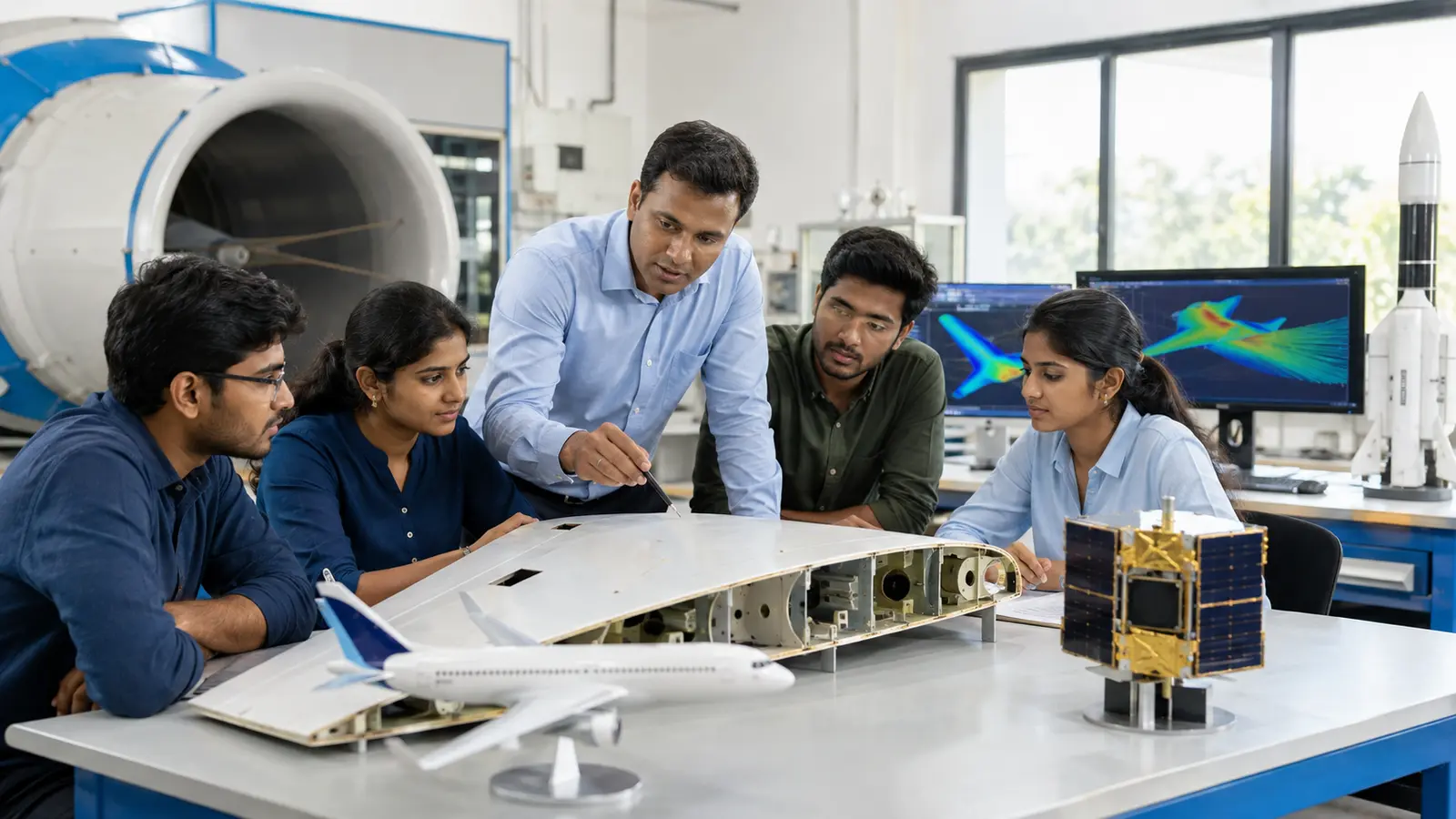
Understanding Aerospace Engineering
Aerospace Engineering develops the scientific and technical knowledge required to create machines that fly within the atmosphere or travel through space. It covers passenger aircraft, military aircraft, helicopters, unmanned aerial vehicles, rockets, satellites, spacecraft and related subsystems.
Students initially study mathematics, physics and foundational engineering. They then progress to aerodynamics, flight mechanics, propulsion, structures, avionics, aircraft design, orbital mechanics, spacecraft systems and specialised electives.
Aerospace systems operate under strict performance and safety requirements. Aircraft must withstand repeated loading, vibration, pressure changes, temperature variation and environmental exposure while remaining light and efficient. Spacecraft may experience intense launch loads, vacuum, radiation, extreme thermal cycles and limited opportunities for repair.
Aerospace engineers consequently use analysis, simulation, experiments and testing to determine whether a design can operate safely and reliably.
Major activities in Aerospace Engineering include:
- Defining mission and performance requirements
- Developing aircraft or spacecraft concepts
- Estimating mass, range, endurance and payload
- Designing aerodynamic surfaces
- Selecting and integrating propulsion systems
- Analysing structural loads and deformation
- Choosing materials
- Developing navigation and control systems
- Designing thermal-management systems
- Performing computer simulations
- Building and testing prototypes
- Conducting wind-tunnel experiments
- Supporting flight testing
- Investigating failures
- Improving reliability
- Planning production and maintenance
- Preparing technical and certification documentation
Aerospace Engineering course highlights
| Particular | General information | |
|---|---|---|
| Course name | Aerospace Engineering | |
| Academic category | Engineering and technology | |
| Major divisions | Aeronautical and Astronautical Engineering | |
| Common UG awards | B.E. and B.Tech | |
| Common PG awards | M.E., M.Tech, M.S. and M.Sc. | |
| Other pathways | Diploma, certificate, integrated degree and PhD | |
| Typical UG duration | Four years | |
| Typical PG duration | Two years | |
| Typical diploma duration | Approximately three years, depending on the programme | |
| General UG eligibility | Class 12 with Physics, Chemistry and Mathematics, subject to institutional rules | |
| General PG eligibility | Relevant recognised bachelor’s degree | |
| Common UG entrance routes | JEE Main, JEE Advanced, state or university admission processes | |
| Common PG entrance route | GATE or an institution-specific selection process | |
| Core subjects | Aerodynamics, propulsion, structures, flight mechanics, controls and space technology | |
| Practical components | Laboratories, simulations, design exercises, internships and projects | |
| Employment sectors | Aviation, space, defence, manufacturing, software, research and consulting | |
| Related branches | Aeronautical, mechanical, electronics, mechatronics and materials engineering |
Aeronautical Engineering and Astronautical Engineering
Aerospace Engineering contains two major areas.
| Aeronautical Engineering | Astronautical Engineering | |
|---|---|---|
| Deals primarily with flight within Earth’s atmosphere | Deals primarily with flight and operation beyond the atmosphere | |
| Covers aeroplanes, helicopters and atmospheric UAVs | Covers rockets, spacecraft, satellites and space vehicles | |
| Emphasises atmospheric aerodynamics | Includes orbital and spaceflight mechanics | |
| Commonly studies aircraft propulsion | Includes rocket and space-propulsion systems | |
| Includes aircraft performance and stability | Includes spacecraft trajectory and attitude control | |
| Works within atmospheric operating conditions | Addresses vacuum, radiation and space-environment conditions |
Both areas use mathematics, structures, materials, control systems, computing, propulsion and systems engineering.
Aerospace Engineering versus Aeronautical Engineering
Aerospace Engineering is the broader discipline. Aeronautical Engineering is a part of Aerospace Engineering that concentrates on aircraft and systems operating in the atmosphere.
An Aerospace Engineering curriculum may include:
- Aircraft design
- Aerodynamics
- Gas-turbine propulsion
- Rocket propulsion
- Spaceflight mechanics
- Satellite systems
- Spacecraft design
- Orbital mechanics
An Aeronautical Engineering curriculum may give greater attention to:
- Aircraft structures
- Aircraft propulsion
- Flight performance
- Aircraft systems
- Aviation technology
- Atmospheric aerodynamics
The actual distinction depends on the university. Some institutions use different titles for programmes with substantial syllabus overlap. Students should compare semester-wise curricula rather than selecting a degree only because one title appears broader.
Aerospace Engineering versus Aircraft Maintenance Engineering
Aerospace Engineering is not the same as Aircraft Maintenance Engineering.
Aerospace Engineering is a degree-oriented design, analysis and development discipline. Aircraft Maintenance Engineering is a specialised professional pathway concerned with inspection, maintenance, repair and certification of operating aircraft under aviation regulations.
An Aerospace Engineering graduate may work in maintenance planning, reliability, technical services or engineering support. However, the degree does not automatically provide an aircraft maintenance licence.
Students interested in licensed aircraft maintenance must review the training, examination and licensing requirements of the appropriate aviation authority.
Aerospace Engineering versus Mechanical Engineering
Mechanical Engineering is a broad discipline covering mechanics, machines, energy, thermal systems, materials, design and manufacturing. Aerospace Engineering builds on many of these principles and applies them to aircraft and spacecraft.
Shared subjects can include:
- Thermodynamics
- Fluid mechanics
- Heat transfer
- Solid mechanics
- Machine design
- Materials science
- Manufacturing
- Vibrations
- Control systems
Aerospace students additionally study topics such as aerodynamics, flight mechanics, propulsion, orbital mechanics, aircraft structures and spacecraft systems.
A mechanical engineering degree can provide a route into postgraduate Aerospace Engineering, subject to the institution’s eligibility conditions.
Aerospace Engineering versus Avionics Engineering
Avionics Engineering focuses on the electronic systems used in aircraft and spacecraft. These include navigation, communication, instrumentation, sensors, embedded systems, flight computers and control electronics.
Aerospace Engineering covers the complete vehicle and normally includes some avionics. An avionics programme gives greater depth to electronics, signals, communication and embedded control.
Major specialisations in Aerospace Engineering
Aerodynamics: Aerodynamics examines airflow around aircraft, rockets and other vehicles. Engineers study lift, drag, pressure, boundary layers, turbulence, shock waves and aerodynamic heating.
Propulsion: Propulsion Engineering deals with systems that generate thrust. It can include propellers, piston engines, gas turbines, turbojets, turbofans, ramjets and rocket engines.
Flight Mechanics: Flight Mechanics studies aircraft motion and performance during take-off, climb, cruise, turning, descent and landing.
Stability and Control: This area examines whether a vehicle returns to a desired condition after a disturbance and how it responds to control inputs.
Aerospace Structures: Aerospace Structures covers wings, fuselages, frames, control surfaces, landing gear and spacecraft structures. Engineers consider stress, deflection, buckling, fatigue, fracture and vibration.
Avionics: Avionics covers instruments, sensors, navigation, communication, embedded electronics and flight computers.
Guidance, Navigation and Control: Guidance determines a desired path, navigation estimates vehicle position and motion, and control produces actions needed to follow the path.
Space Technology: This area includes rockets, spacecraft, satellites, space environments, mission design, attitude control and space propulsion.
Aerospace Materials: Engineers study lightweight alloys, composites, high-temperature materials, ceramics and other materials suited to demanding operating conditions.
Aerospace Manufacturing: This specialisation covers precision machining, composite fabrication, additive manufacturing, joining, assembly, inspection and quality assurance.
Computational Aerospace Engineering: Computational specialists use numerical methods for aerodynamics, structures, heat transfer, control and multidisciplinary design.
Systems Engineering: Systems engineers coordinate requirements and interfaces across the complete vehicle or mission.
Who should study Aerospace Engineering?
Aerospace Engineering may suit students who:
- Enjoy mathematics and physics
- Are interested in aircraft, rockets or satellites
- Like solving complex technical problems
- Can work carefully and systematically
- Are willing to learn programming
- Enjoy design, analysis and experimentation
- Pay close attention to safety
- Can work in multidisciplinary teams
- Are comfortable with continuous learning
- Understand that specialist jobs can be competitive
Interest in aircraft or space exploration can motivate a student, but the curriculum requires much more than enthusiasm. Students must be prepared for calculus, differential equations, thermodynamics, fluid mechanics, solid mechanics, programming and technical laboratories.
Continue your Aerospace Engineering research
Course at a Glance
- Course AreaCore Engineering Disciplines
- Study PathwaysB.E./B.Tech, M.E./M.Tech, M.S. and research pathways
- Primary FocusAircraft, launch vehicles and spacecraft through aerodynamics, structures, propulsion, flight dynamics, orbital mechanics and control.