
Understand aircraft-focused engineering, its technical areas and how it differs from nearby aviation pathways.
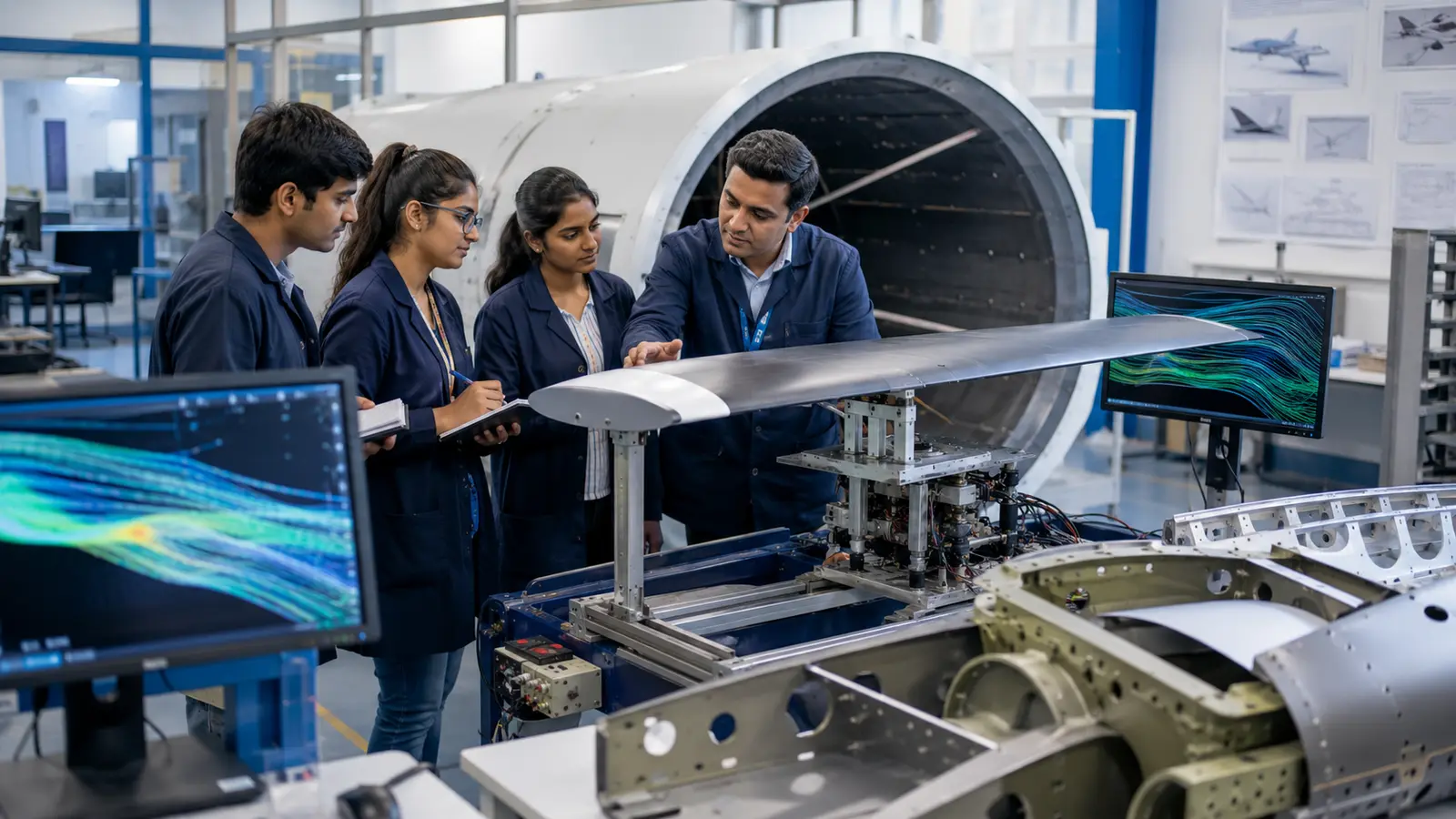
Aeronautical Engineering Course Details – Fees, Subjects, Syllabus, Duration, Eligibility and Career Scope
Aeronautical Engineering is a specialised engineering branch concerned with the design, development, testing, operation and performance of aircraft that fly within Earth’s atmosphere. Students study how an aircraft produces lift, remains stable, carries loads, generates thrust and operates safely under different flight conditions.
The programme combines mathematics, physics, mechanical engineering, materials science, electronics and computer-based analysis. Important study areas include aerodynamics, aircraft structures, propulsion, flight mechanics, control systems, avionics, manufacturing and aircraft design.
Aeronautical engineers may contribute to passenger aircraft, military aircraft, helicopters, unmanned aerial vehicles, aircraft engines, flight-control systems and other aviation technologies. Their work may involve design calculations, computer simulation, laboratory testing, manufacturing support, quality assurance, maintenance planning or technical documentation.
The standard B.E. or B.Tech Aeronautical Engineering programme is generally completed in four years and divided into eight semesters. Postgraduate M.E. or M.Tech programmes usually take two years. Diploma courses commonly take three years after Class 10, while lateral-entry options may permit eligible diploma holders to join the second year of a degree programme.
Aeronautical Engineering is academically demanding because aircraft systems must satisfy strict requirements related to safety, weight, strength, efficiency and reliability. A small design error can affect the performance of the complete aircraft. Students must therefore develop careful calculation, testing, documentation and teamwork habits.
The course may suit students who enjoy:
- Mathematics and Physics
- Aircraft and aviation technology
- Mechanical systems
- Computer-aided design
- Fluid mechanics
- Engines and propulsion
- Practical testing
- Solving complex technical problems
A degree in Aeronautical Engineering does not automatically make a graduate a pilot or a licensed aircraft maintenance engineer. Flying licences and aircraft-maintenance licences follow separate training, examination and regulatory requirements.
What is Aeronautical Engineering?
Aeronautical Engineering studies the science and technology of aircraft that operate mainly within Earth’s atmosphere. It deals with how aircraft are designed, analysed, manufactured, tested and supported throughout their operating life.
An aircraft must perform several functions together. Its wings must produce sufficient lift. The structure must carry aerodynamic, landing and cabin loads. Engines must provide thrust efficiently. Control surfaces must allow the pilot or flight-control system to guide the aircraft. Electrical, hydraulic, fuel and communication systems must operate reliably.
Aeronautical engineers study these connected systems instead of treating an aircraft as a collection of independent parts.
Aerodynamics
Aerodynamics examines how air moves around wings, fuselages, propellers and other aircraft surfaces. Students learn about:
- Lift
- Drag
- Pressure
- Boundary layers
- Airflow separation
- Compressible flow
- Subsonic and supersonic flow
- Wind-tunnel testing
- Computational Fluid Dynamics
Aerodynamic decisions affect speed, fuel use, stability, noise and aircraft range.
Aircraft Structures
Aircraft structures must remain strong while keeping weight as low as practical. Students study:
- Stress and strain
- Bending and torsion
- Thin-walled structures
- Fatigue
- Fracture
- Buckling
- Wings and fuselages
- Landing gear loads
- Structural testing
- Composite materials
Aircraft experience repeated loading during take-off, flight and landing. Engineers must consider how small cracks or material damage may develop over time.
Propulsion
Propulsion deals with systems that produce thrust. Depending on the programme, students may study:
- Piston engines
- Propellers
- Turbojet engines
- Turbofan engines
- Turboprop engines
- Combustion
- Compressors
- Turbines
- Nozzles
- Engine performance
Propulsion engineers work to improve thrust, fuel efficiency, reliability, emissions and noise.
Flight Mechanics
Flight mechanics explains how an aircraft moves and responds during flight. Students study:
- Aircraft performance
- Stability
- Control
- Take-off and landing
- Climb and descent
- Range and endurance
- Manoeuvres
- Flight envelopes
- Aircraft equations of motion
Avionics and Control
Modern aircraft depend on electronic and control systems. Students may learn about:
- Flight instruments
- Navigation
- Communication
- Sensors
- Autopilot
- Flight-control systems
- Embedded systems
- Control theory
- Signal processing
- Aircraft electrical systems
Manufacturing and Maintenance Support
Aeronautical Engineering also covers how aircraft parts are manufactured, inspected and supported. Topics can include:
- Production planning
- Precision manufacturing
- Quality control
- Non-destructive testing
- Aircraft materials
- Repair principles
- Airworthiness
- Reliability
- Technical documentation
Highlights – Aeronautical Engineering
| Particular | Course Information |
|---|---|
| Course name | Aeronautical Engineering |
| Common qualifications | Diploma, B.E., B.Tech, M.E., M.Tech and PhD |
| Undergraduate duration | Generally four years |
| Postgraduate duration | Generally two years |
| Diploma duration | Commonly three years after Class 10 |
| Lateral-entry duration | Usually three years after direct entry into the second year, where permitted |
| Typical UG eligibility | Class 12 with Physics, Chemistry and Mathematics, subject to institution rules |
| Typical PG eligibility | Relevant engineering bachelor’s degree |
| Admission route | National, state, university or institution-level entrance examination |
| Major study areas | Aerodynamics, structures, propulsion, flight mechanics, avionics and aircraft design |
| Common entrance examinations | JEE Main, state CETs, university examinations and GATE for PG programmes |
| Course format | Classroom teaching, laboratories, design work, simulation, projects and internships |
| Career areas | Aircraft design, analysis, testing, manufacturing, quality, maintenance support and research |
| Popular job profiles | Aeronautical Engineer, Design Engineer, Stress Engineer, Aerodynamics Engineer and Flight Test Engineer |
| Employment sectors | Aviation, aircraft manufacturing, defence, research, airlines and engineering services |
| Important clarification | The engineering degree is different from pilot and aircraft-maintenance licensing |
Students should verify the exact degree title because some institutions offer Aerospace Engineering instead of Aeronautical Engineering. These courses overlap but may not have identical syllabi.
Aeronautical Engineering Specialisations and Related Courses
Aeronautical Engineering is connected with several other branches and specialisations.
| Related Course or Specialisation | Main Focus |
|---|---|
| Aerospace Engineering | Aircraft and spacecraft systems |
| Mechanical Engineering | Machines, manufacturing, thermodynamics, structures and design |
| Avionics Engineering | Aircraft electronics, navigation, communication and control |
| Aircraft Maintenance Engineering | Inspection, maintenance and airworthiness under the applicable licensing framework |
| Aerospace Propulsion | Aircraft and rocket engines |
| Aircraft Structures | Structural analysis, materials, fatigue and design |
| Aerodynamics | Airflow, lift, drag and computational analysis |
| Flight Dynamics and Control | Aircraft stability, performance and control systems |
| Defence Technology | Defence systems, platforms, sensors and supporting technologies |
| Unmanned Aerial Vehicle Engineering | Drone design, propulsion, controls, communication and operations |
| Space Engineering | Spacecraft, launch systems and orbital applications |
| Computational Fluid Dynamics | Computer-based analysis of fluid flow and heat transfer |
| Composite Materials | Lightweight fibre-reinforced aircraft structures |
| Aviation Management | Business and operational management of aviation organisations |
Aeronautical Engineering and Aerospace Engineering
Aeronautical Engineering primarily focuses on aircraft operating within Earth’s atmosphere. Aerospace Engineering generally includes both aeronautics and astronautics.
In practice, the curriculum may overlap considerably. Both programmes can contain aerodynamics, propulsion, structures, flight mechanics and control systems. Aerospace programmes may give more attention to spacecraft, rockets and orbital mechanics.
Students should compare the syllabus instead of relying only on the title.
Aeronautical Engineering and Aircraft Maintenance Engineering
These are different pathways.
Aeronautical Engineering is an academic engineering degree concerned with aircraft design, analysis, development and related technical work.
Aircraft Maintenance Engineering is connected with inspection, maintenance, repair and certification responsibilities under the applicable aviation regulations. Licensing requirements are separate from a B.E. or B.Tech degree.
Students interested in maintenance licensing should check the current regulatory pathway rather than assuming that an Aeronautical Engineering degree provides the licence.
Aeronautical Engineering and Pilot Training
Aeronautical engineers design, analyse or support aircraft systems. Pilots operate aircraft.
A degree in Aeronautical Engineering does not provide a pilot licence. Students who want to become pilots must follow the approved flying-training, medical, examination and licensing process.
Continue your Aeronautical Engineering research
Course at a Glance
- Course AreaCore Engineering Disciplines
- Study PathwaysDiploma, B.E./B.Tech, M.E./M.Tech and research pathways
- Primary FocusAircraft design, aerodynamics, structures, propulsion, flight mechanics, avionics, testing and aviation systems.