
Understand programme levels, core subjects, practical learning, specialisations and career pathways.
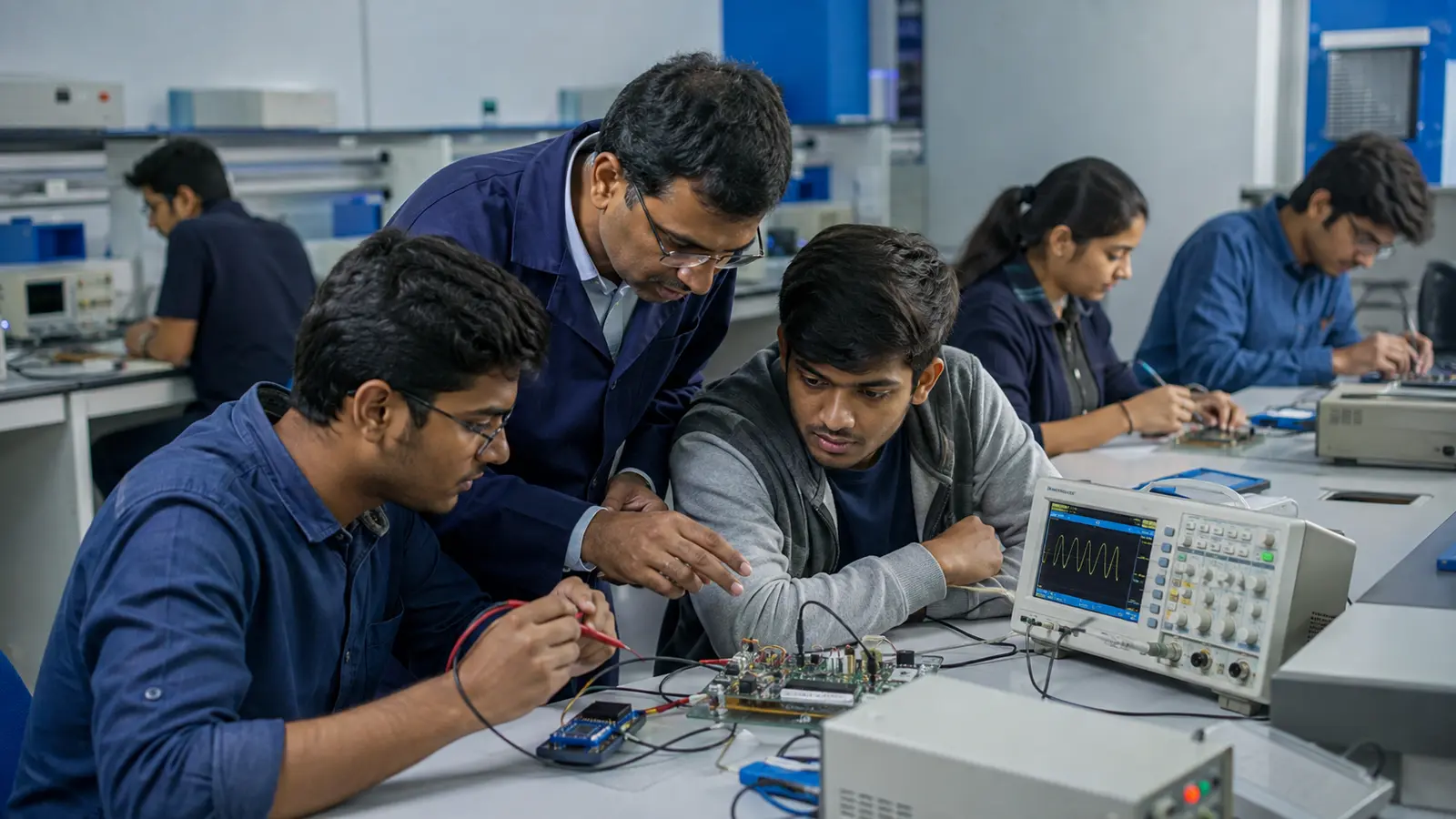
Understanding Electronics Engineering
Electronics Engineering combines semiconductor devices, analogue and digital circuits, Mathematics, programming, signal processing, measurement and control. Engineers design or test circuit boards, processors, embedded systems, sensors, interfaces, power converters, integrated circuits and electronic products.
Consider a wearable health monitor. Sensors detect physical signals, an analogue front end conditions them, converters create digital data, a microcontroller processes the readings and a regulated power circuit runs the device efficiently. Memory, displays and a wireless interface may be added. Electronics engineers can work on the sensors, circuit board, firmware, power system, testing or integrated circuits within this product.
The discipline covers physical hardware, mathematical methods and low-level software. Hardware-oriented work may involve semiconductor circuits, printed circuit boards, sensors, embedded devices, control equipment and testing instruments. System-oriented work includes modelling, signal conditioning, data conversion, feedback, reliability and performance analysis. Software is increasingly important because modern electronic products use programmable controllers, simulations, digital signal processors and automated design tools.
Main areas within Electronics Engineering
Semiconductor devices and analogue electronics cover diodes, transistors, amplifiers, oscillators, filters, biasing and integrated-circuit building blocks. These subjects explain how real electronic hardware generates and processes signals.
Digital electronics and VLSI cover logic gates, combinational and sequential design, hardware description, digital integrated circuits and chip-design flows. Advanced work may include verification, physical design or low-power systems.
Microprocessors and embedded systems combine processors, memory, interfaces, sensors and firmware. They support consumer devices, vehicles, industrial equipment, medical products and connected systems.
Electronic measurements and instrumentation cover sensors, transducers, oscilloscopes, signal generators, measurement uncertainty and data-acquisition systems.
Control and automation electronics cover feedback, actuators, motor interfaces, controllers and industrial electronic systems used to monitor and operate machines.
Power electronics studies semiconductor switches, rectifiers, inverters, converters, motor drives and regulated supplies used in products, renewable-energy systems and electric mobility.
PCB design and electronic product development bring together schematics, component selection, layout, electromagnetic compatibility, prototyping, testing and design for manufacturing.
Sensors and instrumentation connect physical quantities such as temperature, pressure, motion and light with electronic processing, display and control.
Microwave and antenna engineering examines high-frequency circuits and the structures that radiate or receive electromagnetic energy. Applications include radar, mobile networks, satellite links and defence systems.
Signal processing provides mathematical and computational tools to analyse, filter, compress and interpret signals. It supports audio, images, biomedical systems, radar and communication receivers.
Communication electronics remain an important supporting area and cover signal transmission, radio-frequency circuits and interfaces used to connect electronic systems.
Embedded and IoT communication connects sensors, controllers and machines. It brings together low-power electronics, microcontrollers, short-range wireless technologies, cloud connectivity and real-time operation.
Programme levels available in India
| Programme | Common title | Usual entry point | Main purpose |
|---|---|---|---|
| Diploma | Diploma in Electronics and Communication or Telecommunication Engineering | After Class 10 or Class 12, subject to rules | Technician-level foundation and practical training |
| Undergraduate | BE/BTech in Electronics Engineering or Electronics and Telecommunication Engineering | After Class 12 with required science subjects | Broad electronics and communication education |
| Postgraduate | ME/MTech in Electronics Engineering, Communication Systems, Wireless Communication or Signal Processing | After a relevant engineering degree | Advanced technical specialisation and research preparation |
| Doctoral | PhD in communication, signal processing, RF, networks or related area | After an eligible postgraduate degree; institutional rules apply | Original research, advanced development and academic careers |
| Short course | Vendor, laboratory or professional certificate | Varies | Focused skill development in networking, RF tools, embedded systems or communication technologies |
At undergraduate level, a sound programme normally contains a broad base in electronics. Students study circuits, semiconductor devices, digital electronics, microprocessors, control systems and embedded systems alongside communication subjects. This broad base is valuable because communication equipment depends on electronic hardware and computing.
At postgraduate level, students move towards advanced topics such as information theory, detection and estimation, coding theory, wireless channel modelling, multiple-input multiple-output systems, advanced antennas, microwave design, optical networks or statistical signal processing. A dissertation or major project is usually an important part of the programme.
Who should consider this field?
Electronics Engineering may suit students who enjoy Physics and Mathematics and want to understand how connected systems work. Curiosity about mobile phones, radio, satellites, fibre networks, electronics, signals or embedded devices is helpful. Students do not need prior professional knowledge, but they should be willing to work with equations, laboratory instruments and programming.
The field is not limited to repairing communication devices or installing telecom cables. Engineering roles can include design, simulation, testing, optimisation, integration, operation and research. Some jobs are hardware-heavy, some are software-heavy and others involve field deployment or network management.
Students should also recognise that the title of the degree does not guarantee one particular job. Employers assess fundamentals, projects, tools, internships, communication ability and problem-solving. A student who builds strong programming and networking skills may enter software, embedded or network roles. Another student with strong electronics and RF laboratory exposure may move towards hardware testing, antenna or telecom equipment work.
Difference between the academic field and everyday communication
Here, communication means technical transmission of information, not public speaking, journalism, mass communication or business communication. Electronics Engineering is a mathematical and technology-based discipline. It studies signals, electronic systems, electromagnetic waves, channels, networks and devices.
ECE overlaps with Electronics Engineering and Telecommunication Engineering but is broader than communication alone. Candidates should examine the actual syllabus. A balanced programme should include devices, analogue and digital circuits, microprocessors, embedded systems, signals, communication, RF, antennas and laboratories.
Applications of Electronics Engineering
Communication technology is used across the economy. Major applications include:
- cellular voice and broadband networks;
- fibre-to-the-home and long-distance optical networks;
- satellite television, satellite internet and navigation;
- radio and digital broadcasting;
- aviation, maritime and railway communication;
- radar, electronic systems and secure defence links;
- emergency and public-safety networks;
- industrial automation and machine-to-machine communication;
- connected vehicles and intelligent transport;
- smart meters, agricultural sensors and IoT devices;
- telemedicine and remote health monitoring;
- data centres and enterprise network infrastructure.
The course therefore gives students access to several career directions, but meaningful progression requires continuous learning. Communication standards, semiconductor capabilities, software tools and network architectures change over time. Strong fundamentals make it easier to adapt.
Continue your Electronics Engineering research
Course at a Glance
- Course AreaComputing and Emerging Technology
- Study PathwaysDiploma, B.E./B.Tech, M.E./M.Tech, certificates and doctoral study
- Primary FocusStudy Electronics Engineering eligibility, syllabus, fees, entrance exams, colleges, skills and career scope in India.