
Understand programme levels, core subjects, practical learning, specialisations and career pathways.
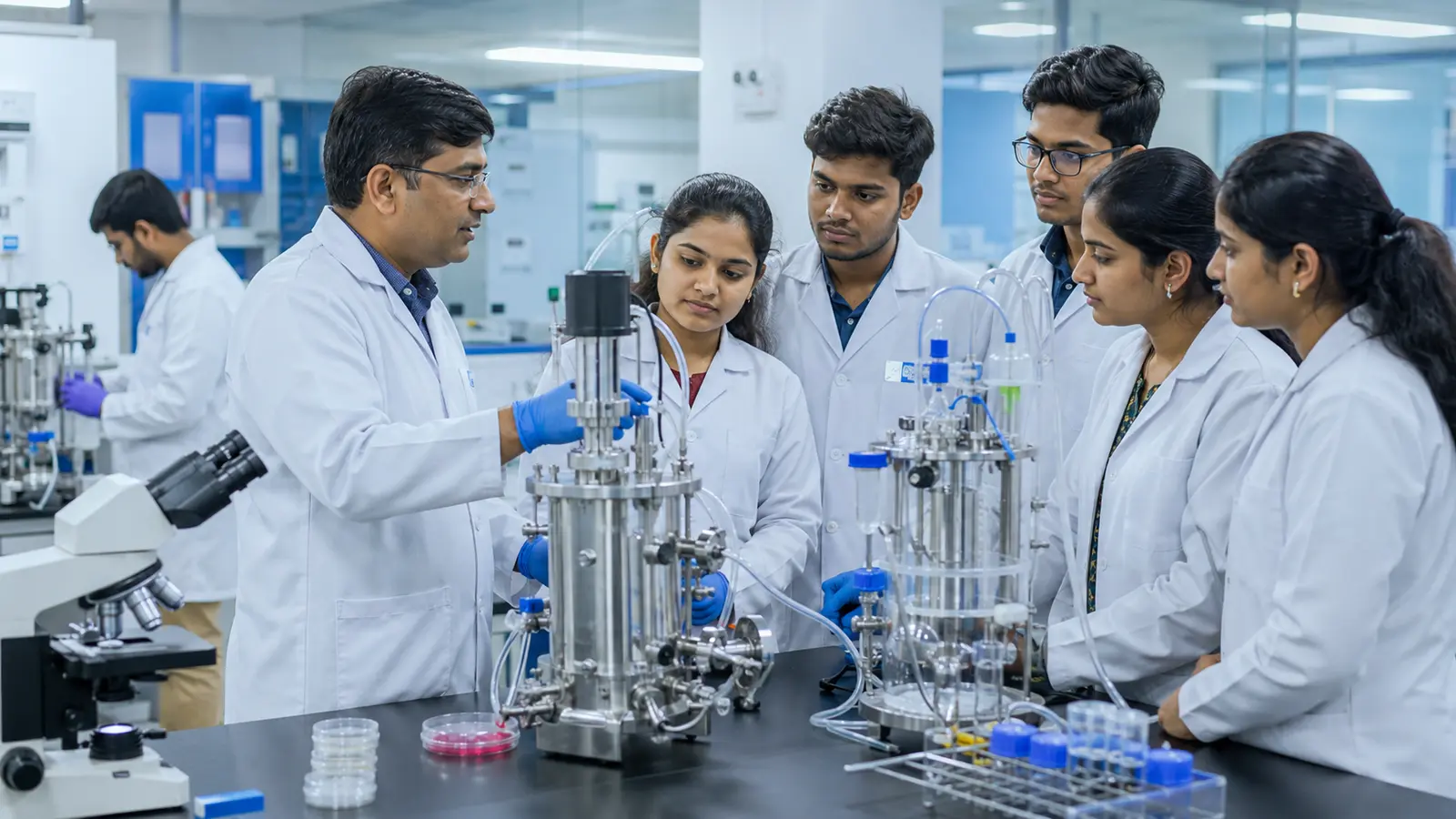
Understanding Biotechnology Engineering
Biotechnology is the controlled use of organisms, cells or biological components for a useful purpose. Engineering adds the ability to design, scale, control and optimise a process. Biotechnology Engineering therefore goes beyond observing biological activity. It asks how that activity can be reproduced safely at a larger scale, measured accurately, operated economically and maintained at an acceptable quality.
A scientist may identify a microorganism that produces a valuable enzyme. A biotechnology engineer helps determine the right nutrient medium, temperature, acidity, oxygen supply and bioreactor conditions for producing that enzyme consistently. The engineer also considers separation, purification, waste treatment, contamination control, process economics and regulatory requirements. This connection between biological science and industrial implementation is central to the course.
Biotechnology Engineering course highlights
| Particular | General details |
|---|---|
| Course name | Biotechnology Engineering |
| Common undergraduate titles | BTech Biotechnology, BTech Biotechnology Engineering and BE Biotechnology |
| Course level | Diploma, undergraduate, postgraduate and doctoral |
| UG duration | Usually four years or eight semesters |
| PG duration | Usually two years or four semesters |
| Basic UG qualification | Class 12 or equivalent in the science stream |
| Subject requirement | PCM, PCB or PCMB depending on the institution and admission route |
| Common admission routes | National, state or university entrance examination; counselling; or merit, depending on the college |
| Major study areas | Cell biology, microbiology, biochemistry, genetics, molecular biology, bioprocess engineering and downstream processing |
| Practical components | Laboratory courses, projects, seminars, industrial training and internships |
| Employment sectors | Biotechnology, pharmaceuticals, diagnostics, food, agriculture, healthcare, bioinformatics, research and environmental services |
| Higher-study options | MTech, MSc, MS, MBA, postgraduate diploma and PhD |
What students study in Biotechnology Engineering
The first year commonly develops a base in science and engineering. Depending on the university, students may study engineering mathematics, chemistry, physics, basic electrical or mechanical engineering, programming, engineering drawing and introductory biology. Students from a mathematics background may receive foundational biology support, while students from a biology background may need to work harder on mathematics and quantitative subjects.
Later semesters move into cell biology, microbiology, biochemistry, molecular biology, genetics, immunology, recombinant DNA technology and bioinformatics. Engineering-oriented subjects include mass and energy balances, thermodynamics, transport processes, reaction engineering, instrumentation, fermentation technology, bioreactor design and downstream processing. The final stages often include electives, industrial exposure and a major project.
Laboratory work is important. Students may learn microbial culture, sterilisation, microscopy, biochemical estimation, electrophoresis, chromatography, DNA isolation, polymerase chain reaction demonstrations, enzyme assays, tissue culture and fermentation operations. The actual experiments depend on the facilities, biosafety permissions and curriculum of the institution.
Major branches and application areas
Medical and pharmaceutical biotechnology uses biological knowledge in diagnostics, vaccines, therapeutic products and drug-development support. Industrial biotechnology uses cells and enzymes to manufacture chemicals, materials, food ingredients and other products. Agricultural biotechnology works with plant tissue culture, molecular breeding, biological inputs and crop-related technologies. Environmental biotechnology applies biological processes to wastewater, waste, pollution and resource recovery.
Food biotechnology deals with fermentation, cultures, enzymes, preservation and quality. Bioinformatics uses computing and statistics to organise and analyse biological information. Synthetic biology, systems biology, genomics, proteomics and computational biology are growing areas, but students generally need strong postgraduate training or specialised skills for advanced work.
Biotechnology Engineering and related programmes
Course names can look similar, yet curricula may differ. A BSc Biotechnology programme is generally more science-oriented, while BTech Biotechnology normally includes a greater engineering and process component. Biochemical Engineering concentrates strongly on processes that use biological or biochemical reactions. Bioengineering is a broad umbrella that may include biological systems, biomaterials and other engineering applications. Biomedical Engineering focuses more on medical devices, instrumentation, imaging and healthcare engineering.
Applicants should compare the semester-wise curriculum rather than relying only on the title. A strong Biotechnology Engineering programme should offer a sensible combination of biology, engineering fundamentals, laboratory practice, computation, process development, project work and exposure to quality and safety.
Who should choose this course?
The course may suit students who are curious about living systems and comfortable learning across several disciplines. It is particularly relevant for those who want to connect biology with production, process design, data or technology. Patience is valuable because laboratory work can involve repeated trials, careful documentation and strict protocols.
Students should not choose the branch only because biotechnology appears to be a futuristic field. They should be willing to study chemistry, quantitative methods, engineering calculations and computing along with biology. They must also understand that many high-end research roles require education beyond the bachelor's level. A realistic interest in the subject and a plan for skill development are more useful than expectations of an immediate scientist position.
Advantages of studying Biotechnology Engineering
The interdisciplinary curriculum gives graduates a broad view of life science and engineering. They can explore manufacturing, quality, research support, regulatory work, technical business roles, data-oriented biology or higher education. Biotechnology also contributes to important social needs, including affordable healthcare, food security, sustainable production and environmental management.
The breadth of the course can, however, become a limitation if a student graduates without depth. Employers usually recruit for a defined task, not simply for broad biotechnology knowledge. Students should therefore develop a clear strength such as bioprocessing, analytical techniques, molecular methods, quality assurance, bioinformatics or regulatory documentation.
Limitations students should understand
Laboratories, consumables and trained supervision strongly affect educational quality. A college may list many advanced subjects but provide limited hands-on exposure. Entry-level salaries can be modest in some laboratory and production roles. Research progress can be slow, and regulated industries demand careful documentation rather than quick experimentation.
The sector is also concentrated around particular industrial and research locations. A graduate may need to relocate for a suitable opportunity. None of these limitations makes the course unsuitable, but students should assess facilities, internships, alumni outcomes and their willingness to pursue specialised training before joining.
Course levels available in India
A diploma can introduce laboratory or production fundamentals and may provide a lateral-entry route where regulations permit. The BTech or BE is the main engineering qualification and normally lasts four years. Integrated programmes combine undergraduate and postgraduate study over a longer period. At postgraduate level, students can specialise in biotechnology, industrial biotechnology, bioprocess engineering, bioinformatics, genetic engineering or related subjects.
Doctoral study is research-intensive and normally requires a relevant postgraduate qualification, although eligibility differs by institution. Short certificates in areas such as bioinformatics, quality systems, clinical data, biostatistics or regulatory affairs can strengthen a profile, but they should complement rather than replace a recognised degree and practical competence.
Learning outcomes
By graduation, a capable student should be able to explain important biological processes, perform routine laboratory work safely, interpret experimental data and understand how biological production systems are designed. The graduate should recognise contamination risks, describe upstream and downstream operations, follow documentation practices and communicate scientific findings.
Engineering judgement develops gradually. It includes selecting suitable process conditions, understanding measurement limitations, balancing product quality with cost and recognising when a proposed biological process is unsafe or impractical. A graduate is not expected to master every biotechnology field, but should possess a dependable foundation for employment or advanced study.
Biotechnology Engineering in the Indian context
India has established pharmaceutical, vaccine, diagnostics, agricultural, food-processing and information-technology capabilities. These create opportunities at the intersection of biology, manufacturing and data. The wider ecosystem includes private companies, universities, research laboratories, hospitals, testing organisations, start-ups and government-supported innovation centres.
At the same time, opportunity is not uniform across every specialisation. Students should track where their chosen skills are actually used. Bioprocess students may target fermentation and manufacturing clusters; molecular biology learners may seek research or diagnostic laboratories; bioinformatics students need coding and statistics; and quality-focused students should understand regulated documentation. Connecting the course to an identifiable job family makes career planning more practical.
Important questions before selecting a college
Applicants should examine whether the department has functional microbiology, molecular biology, biochemistry and bioprocess laboratories. They should ask how often students perform experiments themselves, whether costly equipment is accessible to undergraduates and how laboratory safety is managed. Faculty specialisation, funded projects, recent publications and industry collaboration can indicate academic activity, although numbers alone do not guarantee teaching quality.
Students should also review the curriculum, internship system, final-year projects, placement data specific to biotechnology and higher-study outcomes. A general university placement figure may be dominated by computing branches. Applicants should request branch-wise information and check whether advertised recruiters actually hired biotechnology students for relevant roles.
Ethical responsibility
Biotechnology can affect health, food, ecosystems and personal genetic information. Students therefore study biosafety, bioethics, intellectual property, risk assessment and responsible research. Technical ability must be accompanied by honest reporting, informed consent where relevant, correct waste disposal, protection of confidential data and respect for regulation.
Ethics is not an optional discussion added after the science. Selective reporting, weak documentation or careless containment can invalidate research and cause harm. Responsible conduct is one of the most important professional outcomes of the course.
Is Biotechnology Engineering a good course?
It can be a good choice for a student who genuinely likes biological science, accepts engineering and quantitative study, and is ready to build practical depth. It is less suitable for someone seeking a clinical medical career or expecting every biotechnology job to involve dramatic discoveries. The value of the qualification depends on the college, laboratory exposure, projects, internships, specialised skills and willingness to continue learning.
Continue your Biotechnology Engineering research
Course at a Glance
- Course AreaApplied and Interdisciplinary Engineering
- Study PathwaysDiploma, B.E./B.Tech, integrated degrees, M.E./M.Tech, M.Sc., certificates and doctoral study
- Primary FocusMolecular biology, microbiology, genetics, biochemistry, bioprocess engineering, bioinformatics, quality and scale-up.