
Understand programme levels, core subjects, practical learning, specialisations and career pathways.
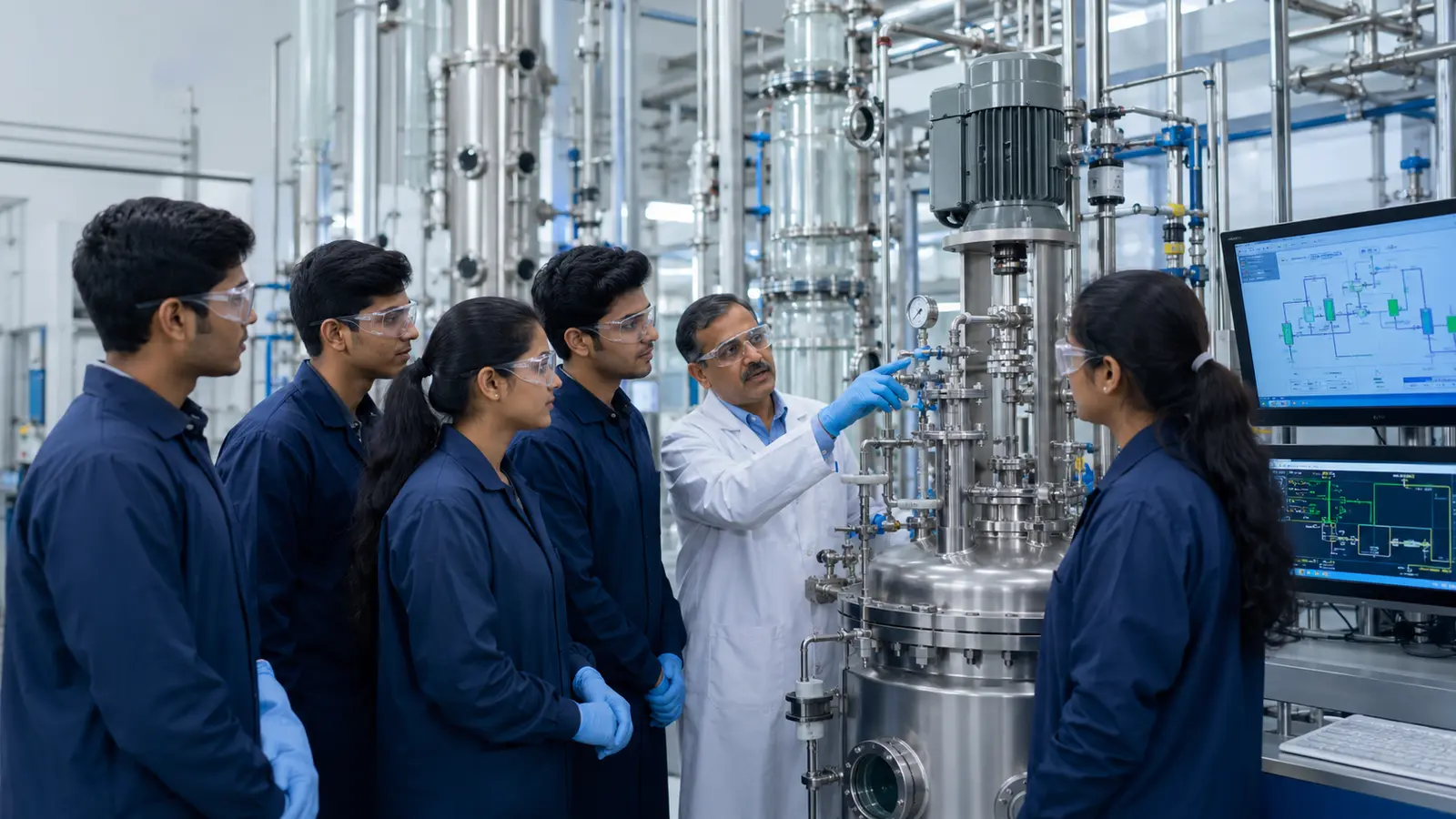
Understanding Chemical Engineering
Chemical Engineering focuses on processes in which materials change in composition, phase, temperature, pressure or physical form. It deals with both chemical reactions and physical operations. Distillation of a liquid mixture, drying a food product, filtering wastewater and compressing a gas are chemical-engineering operations even when no chemical reaction occurs.
The discipline is built around a set of core ideas. Material balances track what enters, leaves, reacts and accumulates. Energy balances track heat and work. Thermodynamics indicates whether a transformation is possible and how phases behave. Transport phenomena explains the movement of momentum, heat and mass. Reaction engineering studies how reactions proceed in industrial reactors.
Chemical Engineering course highlights
| Particular | General details |
|---|---|
| Course name | Chemical Engineering |
| Common degree titles | BTech Chemical Engineering and BE Chemical Engineering |
| Course level | Diploma, undergraduate, postgraduate and doctoral |
| UG duration | Four years or eight semesters |
| Diploma duration | Usually three years |
| PG duration | Usually two years |
| Basic UG qualification | Class 12 with the required science subjects, commonly PCM |
| Common entrance routes | JEE Advanced, JEE Main, MHT CET, state CETs and university tests |
| Core subjects | Thermodynamics, fluid mechanics, heat transfer, mass transfer and reaction engineering |
| Practical components | Laboratories, process simulation, industrial training, design project and seminar |
| Main industries | Chemicals, petroleum, energy, pharmaceuticals, food, polymers, fertilisers and water |
| Common roles | Process engineer, production engineer, design engineer, safety engineer and quality professional |
Meaning of a chemical process
A chemical process is an organised sequence that changes raw materials into desired products. It can include storage, pumping, mixing, reaction, heating, cooling, separation, purification and packaging. Streams that do not become product may be recycled, treated or safely disposed of.
An engineer represents the process using flow diagrams and balances. This provides a systematic view of equipment, material movement, energy needs and control points.
Scientific foundation of Chemical Engineering
Chemical Engineering uses Chemistry to understand substances and reactions, then combines it with Mathematics, Physics, Biology, economics and engineering design. Students connect molecular behaviour with flow, heat, mass transfer, reaction systems, equipment and industrial operation.
This foundation helps engineers determine whether a process is feasible, how it should be scaled, which materials and equipment are suitable, how energy can be managed and how safe product quality can be maintained.
Scale-up
Scale-up means moving from laboratory or pilot results to a larger production system. A process cannot simply be enlarged geometrically. Mixing, heat removal, pressure drop, mass transfer and safety behaviour change with scale.
Chemical engineers use models, pilot tests and experience to manage this transition. Scale-up is especially important in pharmaceuticals, biotechnology, speciality chemicals and new materials.
Unit operations
Unit operations are common physical steps used across industries. Examples include distillation, filtration, drying, evaporation, absorption, extraction, crystallisation and membrane separation.
A distillation column may separate petroleum fractions, solvents or alcohol mixtures. The equipment differs in size and operating conditions, but the underlying mass-transfer principles remain similar.
Unit processes and reactions
Unit processes involve chemical conversion, such as oxidation, polymerisation, hydrogenation or neutralisation. Modern curricula often integrate these with reaction engineering rather than teach them only as named industrial reactions.
Engineers select reactor type, temperature, pressure, catalyst and residence time. They must control heat release and avoid unsafe reaction conditions.
Material balances
Material balances follow conservation of mass. Students calculate feed, product, recycle, purge and waste streams. When reactions occur, stoichiometry and conversion are included.
These balances are the foundation of equipment sizing, utility calculation and economic analysis. A process design built on an incorrect material balance cannot be reliable.
Energy balances
Energy balances account for heat, work and changes in stream energy. They help determine heating, cooling, compression and power requirements. Energy integration can reduce utility use and emissions.
Chemical Engineering Thermodynamics
Thermodynamics explains phase equilibria, chemical equilibrium and energy relationships. It helps predict whether vapour and liquid phases will separate, which conditions favour a reaction and how much work or heat is involved.
Industrial mixtures rarely behave ideally. Engineers use property models and reliable data to design equipment.
Transport phenomena
Transport phenomena brings momentum, heat and mass transfer into a common framework. Fluid flow transports momentum, temperature differences drive heat transfer, and concentration differences drive mass transfer.
Understanding these mechanisms helps engineers analyse pipelines, heat exchangers, dryers, reactors and separation equipment.
Fluid mechanics
Fluid mechanics studies liquids and gases at rest and in motion. Topics include pressure, flow, viscosity, pipe losses, pumps, compressors and flow measurement.
Plant operation depends on moving fluids safely. Incorrect pressure-drop calculations can cause inadequate flow, excessive energy use or equipment problems.
Heat transfer
Heat transfer occurs through conduction, convection and radiation. Chemical plants use heat exchangers, boilers, condensers, evaporators and furnaces to control temperature.
Engineers size heat-transfer area, select utility conditions and account for fouling. Poor temperature control can reduce quality or create hazards.
Mass transfer
Mass transfer is the movement of chemical species caused by concentration or chemical-potential differences. It governs distillation, absorption, extraction, drying and membrane processes.
Students learn equilibrium stages, transfer coefficients and equipment design. Separation often accounts for a large part of plant energy and cost.
Reaction engineering
Reaction engineering combines kinetics with flow, mixing and heat transfer to design reactors. Students study batch, continuous stirred-tank and plug-flow reactors, along with catalytic and multiphase systems.
Safety is central because reactions can release heat, pressure or hazardous substances. Reactor design must consider control and emergency response.
Process control
Process control maintains variables such as temperature, pressure, level, flow and composition within desired limits. Sensors measure the plant, controllers calculate corrective action and valves or other devices adjust operation.
Automation improves consistency but does not remove the need for trained operators and engineers. Instruments can fail or provide misleading data.
Process design
Process design turns an idea into an integrated plant. Engineers prepare flow diagrams, calculate streams, select equipment, estimate utilities, analyse safety and evaluate cost.
Design involves iteration. A change in reactor conditions can affect separation, energy, materials of construction and waste treatment.
Plant operation
Operating engineers monitor production, quality, equipment, utilities and safety. They investigate deviations and coordinate maintenance. Real plants face feed variation, fouling, corrosion, breakdowns and market changes.
Process safety
Chemical plants can contain flammable, toxic, corrosive or high-pressure materials. Process safety aims to prevent major loss of containment, fire, explosion and toxic release.
Students learn hazard identification, relief systems, safe design, operating procedures and emergency planning. Safety is a design responsibility, not an optional compliance activity.
Occupational safety
Occupational safety addresses daily risks such as chemical exposure, hot surfaces, machinery, confined spaces, noise and falls. It complements process safety. Engineers must respect permits, protective equipment and isolation procedures.
Environmental responsibility
Chemical engineers design water, air and waste-treatment systems and reduce pollution at its source. They work on cleaner production, recycling, energy efficiency and safer materials.
Compliance is the minimum requirement. Good engineering also asks whether a process can use fewer resources and create less hazard.
Petrochemicals and refining
Refineries separate crude oil and convert fractions into fuels and feedstocks. Petrochemical plants produce building blocks for plastics, fibres, solvents and chemicals. Chemical engineers work in process, operations, design, safety and optimisation.
The energy transition may change product demand, but refining and petrochemical knowledge remains relevant to existing assets and chemical feedstocks.
Fertilisers
Fertiliser plants manufacture ammonia, urea, phosphates and other agricultural inputs. They use high pressure, catalysis, separation and large-scale utilities. Engineers manage production, energy, emissions and safety.
Pharmaceuticals
Pharmaceutical processes include reaction, crystallisation, filtration, drying, solvent recovery and formulation. Quality, cleanliness, documentation and validation are critical.
Chemical engineers contribute to process development and manufacturing, but pharmacy and chemistry graduates may have different responsibilities. A BTech does not qualify a person for every pharmaceutical role.
Food processing
Food production uses heat transfer, drying, evaporation, refrigeration, mixing, fermentation and packaging. Engineers must understand hygiene, food safety and product sensitivity.
Polymers and plastics
Polymer industries use reaction engineering, extrusion, compounding and product processing. Engineers work with resins, fibres, elastomers, coatings and composites. Recycling and alternative materials are important challenges.
Biochemical engineering
Biochemical engineering applies process principles to cells, enzymes and biological products. Fermentation, bioreactors and downstream processing are key areas. Students may take it as an elective or pursue postgraduate specialisation.
Water and wastewater
Chemical engineers design treatment involving coagulation, filtration, membranes, adsorption, biological processes and disinfection. Industrial wastewater requires source-specific treatment and recovery.
Energy and hydrogen
The discipline contributes to conventional energy, batteries, biofuels, hydrogen, carbon management and renewable-process integration. New energy systems still require balances, reactors, separation, materials and safety.
Who should choose Chemical Engineering?
The course may suit students who enjoy Mathematics, Chemistry and Physics and want to solve large-scale industrial problems. They should be willing to study equations, equipment, safety and economics.
Students should understand that Chemical Engineering is not mainly laboratory Chemistry. It involves significant mathematics, thermodynamics and process analysis.
Advantages of the course
Chemical Engineering principles apply across many industries. This breadth provides flexibility and supports careers in manufacturing, design, consulting, energy, environment and research.
The branch also develops strong quantitative problem-solving that can support movement into analytics, management and finance after suitable preparation.
Limitations students should understand
Many core jobs are located in industrial plants and may involve shifts or relocation. Entry-level work can be operational and demanding. Safety responsibilities are serious.
Students who graduate without internships, simulation ability or practical understanding may struggle to demonstrate job readiness. Advanced R&D roles often require postgraduate study.
Is Chemical Engineering a good course?
It can be an excellent course for students interested in processes, materials and industrial problem-solving. Its value depends on the college, laboratories, internship, technical depth and willingness to work in relevant sectors.
Continue your Chemical Engineering research
Course at a Glance
- Course AreaChemical and Process Engineering
- Study PathwaysDiploma, B.E./B.Tech, M.E./M.Tech, M.Sc., certificates and doctoral study
- Primary FocusMaterial and energy balances, transport, reactions, separations, process control, design, safety and sustainability.