
Explore Food Technology programme structure, core subjects, practical learning and career pathways.
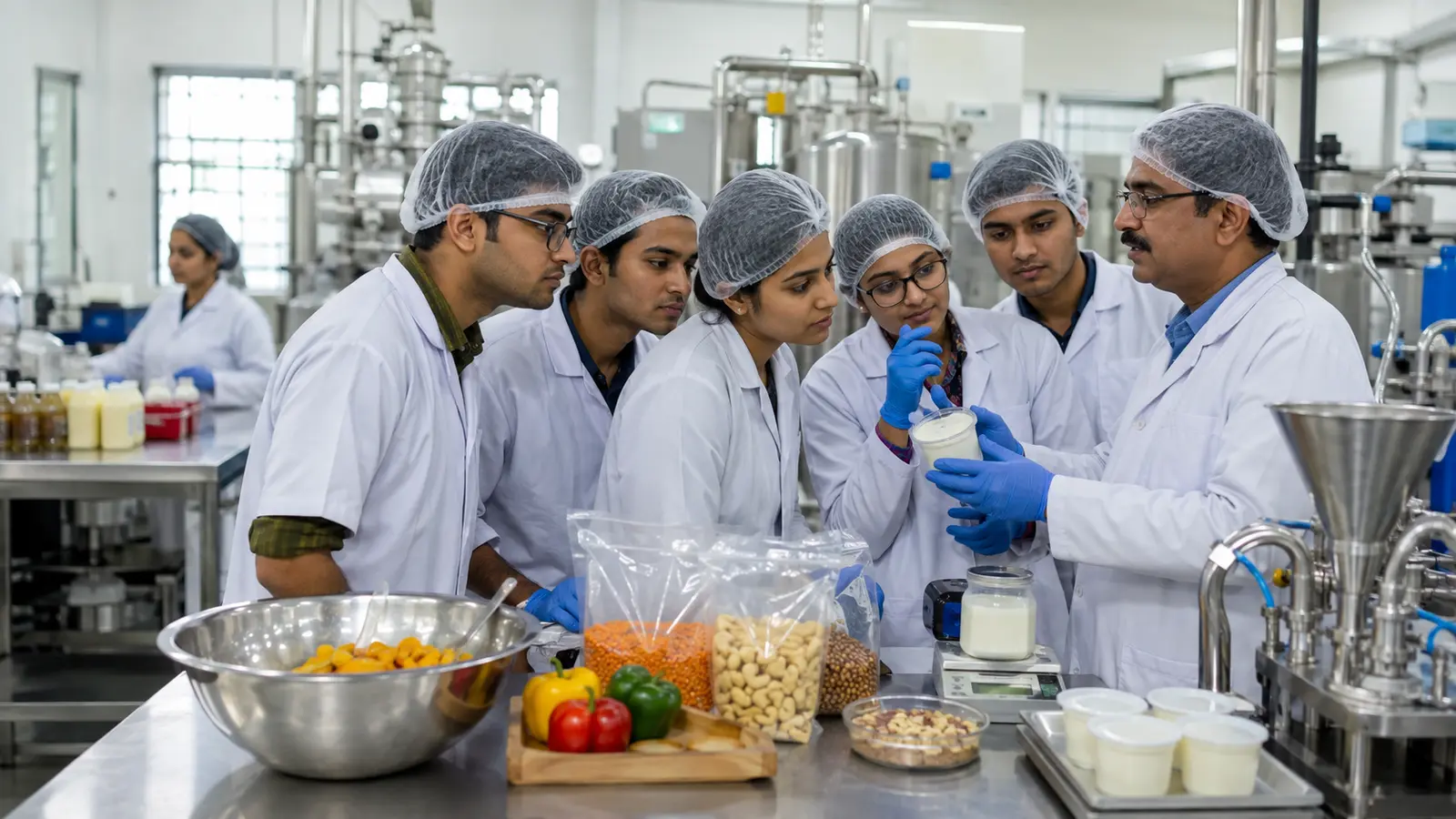
Understanding Food Technology
Food Technology follows food from raw-material reception through cleaning, grading, processing, preservation, packaging, storage and distribution. Operations must control hazards and quality while retaining desirable sensory and nutritional properties.
The discipline uses material and energy balances, heat and mass transfer, food chemistry, microbial kinetics and process control. It also relies on sensory evaluation, statistical quality control, traceability and hygiene systems because technically efficient processing is useless if the food is unsafe or unacceptable.
Food Technology course highlights
| Particular | General details |
|---|---|
| Course name | Food Technology |
| Common degree titles | BTech Food Technology and BE Food Technology |
| Course level | Diploma, undergraduate, postgraduate and doctoral |
| UG duration | Four years or eight semesters |
| Diploma duration | Usually three years |
| PG duration | Usually two years |
| Basic UG qualification | Class 12 Science; accepted PCM/PCB combinations vary by programme |
| Common entrance routes | JEE Advanced, JEE Main, MHT CET, state CETs and university tests |
| Core subjects | Food chemistry, microbiology, processing, preservation, packaging and quality assurance |
| Practical components | Food laboratories, pilot processing, sensory evaluation, industrial training and projects |
| Main industries | Dairy, beverages, cereals, bakery, fruits and vegetables, meat, ingredients and packaging |
| Common roles | Food technologist, quality executive, production trainee, R&D associate and food-safety professional |
Food-processing chain
The food-processing chain begins with sourcing and receiving agricultural, dairy, marine or animal raw materials. It then includes inspection, cleaning, grading, size reduction, formulation, processing, preservation, packaging, storage and distribution. Each stage can affect safety, quality, nutrition, cost and shelf life.
Technologists use process-flow diagrams, material balances and hazard-control plans to study this chain. They also consider traceability, allergen separation, sanitation, temperature control and the use or treatment of by-products.
Food Technology and Food Science
Food Science studies the physical, chemical, biological and sensory properties of food. Food Technology applies this scientific knowledge to preservation, processing, packaging, quality assurance and commercial production. The two areas overlap strongly, and universities may organise them differently.
A science-led programme may give more attention to food chemistry, microbiology, nutrition and product analysis. An engineering-led Food Technology programme usually adds process calculations, heat and mass transfer, refrigeration, equipment and plant design. Applicants should compare the actual syllabus.
Scale-up
Scale-up means moving a food product from a kitchen or laboratory trial to pilot and industrial production. A larger batch may heat, cool, mix or dry differently, so the recipe cannot simply be multiplied.
Food technologists use trials, measurements and process models to preserve texture, flavour, safety and pack consistency at production scale. They also check equipment capacity, cleaning, labour, waste, cost and regulatory requirements.
Unit operations
Unit operations are common processing steps such as cleaning, sorting, peeling, milling, mixing, filtration, centrifugation, homogenisation, pasteurisation, evaporation, drying, freezing and packaging. The same principle may be applied to milk, fruit juice, grain, edible oil or another food under different conditions.
Students learn what each operation does, how it affects microorganisms and product quality, and how to select operating time, temperature, pressure or flow for a particular food.
Preservation methods
Preservation methods slow microbial, enzymatic and chemical deterioration. Common approaches include heating, refrigeration, freezing, drying, fermentation, concentration, approved preservatives, irradiation where permitted, high-pressure processing and protective packaging.
No method is suitable for every product. Selection depends on the target organisms, pH, water activity, heat sensitivity, desired shelf life, distribution conditions, cost and legal requirements. Several mild barriers may be combined in hurdle technology.
Material balances
Material balances follow conservation of mass. Students calculate feed, product, recycle, purge and waste streams. When reactions occur, stoichiometry and conversion are included.
These balances are the foundation of equipment sizing, utility calculation and economic analysis. A process design built on an incorrect material balance cannot be reliable.
Energy balances
Energy balances account for heat, work and changes in stream energy. They help determine heating, cooling, compression and power requirements. Energy integration can reduce utility use and emissions.
Food engineering and thermodynamics
Food engineering uses thermodynamics to analyse heating, cooling, freezing, evaporation, refrigeration and phase changes. Water activity, vapour pressure, enthalpy and equilibrium relationships help explain product stability and equipment energy needs.
Foods are complex mixtures rather than ideal pure substances. Reliable product data and experiments are therefore important when selecting or designing a process.
Transport phenomena
Transport phenomena brings momentum, heat and mass transfer into a common framework. Fluid flow transports momentum, temperature differences drive heat transfer, and concentration differences drive mass transfer.
Understanding these mechanisms helps students analyse pipelines, heat exchangers, evaporators, dryers, freezers and membrane equipment.
Role of fluid mechanics
Fluid mechanics studies liquids and gases at rest and in motion. Topics include pressure, flow, viscosity, pipe losses, pumps, compressors and flow measurement.
Plant operation depends on moving fluids safely. Incorrect pressure-drop calculations can cause inadequate flow, excessive energy use or equipment problems.
Role of heat transfer
Heat transfer occurs through conduction, convection and radiation. Food plants use heat exchangers, pasteurisers, retorts, evaporators, dryers, freezers and refrigeration systems to control product temperature.
Engineers size heat-transfer area, select utility conditions and account for fouling. Poor temperature control can reduce quality or create hazards.
Role of mass transfer
Mass transfer describes movement of moisture or dissolved components caused by concentration differences. It governs extraction, drying, humidification, salting and membrane processes.
Students learn equilibrium stages, transfer coefficients and equipment design. Separation often accounts for a large part of plant energy and cost.
Reaction kinetics in food processing
Food-reaction kinetics describes how microbial populations, enzymes, nutrients, pigments, flavours and oxidation change with time and temperature. These models help select processing and storage conditions.
Safety is central because microbial growth or excessive chemical change can make food unacceptable or unsafe. Process selection must therefore consider validated time-temperature conditions, hygienic design and reliable monitoring.
Process control
Process control maintains variables such as temperature, pressure, level, flow and composition within desired limits. Sensors measure the plant, controllers calculate corrective action and valves or other devices adjust operation.
Automation improves consistency but does not remove the need for trained operators and engineers. Instruments can fail or provide misleading data.
Process design
Process design turns an idea into an integrated plant. Engineers prepare flow diagrams, calculate streams, select equipment, estimate utilities, analyse safety and evaluate cost.
Design involves iteration. A change in heating, mixing or packaging can affect safety, texture, nutrition, equipment, energy and waste treatment.
Plant operation
Operating engineers monitor production, quality, equipment, utilities and safety. They investigate deviations and coordinate maintenance. Real plants face feed variation, fouling, corrosion, breakdowns and market changes.
Process safety
Food plants contain hot surfaces, steam, refrigeration systems, pressure equipment, dust, cleaning chemicals, moving machinery and sometimes combustible powders. Process safety aims to prevent burns, leaks, fire, explosion, chemical exposure and equipment failure.
Students learn hazard identification, hygienic design, safe operating procedures, emergency planning and controls for utilities and machinery. Food safety and worker safety are related but distinct responsibilities.
Occupational safety
Occupational safety addresses daily risks such as chemical exposure, hot surfaces, machinery, confined spaces, noise and falls. It complements process safety. Engineers must respect permits, protective equipment and isolation procedures.
Environmental responsibility
Food technologists and environmental engineers reduce water, energy, effluent and solid waste at source. They work on cleaner production, by-product use, recycling and safer materials.
Compliance is the minimum requirement. Good engineering also asks whether a process can use fewer resources and create less hazard.
Dairy technology
Dairy technology covers milk reception, clarification, standardisation, pasteurisation, homogenisation, fermentation, concentration, drying and manufacture of products such as curd, cheese, butter, ice cream and milk powder. Cold-chain control, cleaning and microbial quality are central.
Cereals, pulses and bakery technology
Cereal and pulse processing includes cleaning, milling, parboiling, extrusion, malting and storage. Bakery technology examines flour quality, dough development, fermentation, baking, texture, staling and packaging. Moisture and pest control influence grain safety.
Fruits and vegetable processing
Fruit and vegetable processing includes washing, grading, peeling, blanching, pulping, juice extraction, canning, freezing, drying and preparation of preserves. Students study browning, texture loss, vitamin retention, microbial stability and seasonal raw-material variation.
Food processing
Food production uses heat transfer, drying, evaporation, refrigeration, mixing, fermentation and packaging. Engineers must understand hygiene, food safety and product sensitivity.
Food packaging
Food packaging protects products from moisture, oxygen, light, microorganisms, impact and tampering while carrying required information. Students examine glass, metal, paper, plastics, multilayer materials, sealing, migration, shelf-life testing and sustainable pack choices.
Fermentation and biotechnology
Food biotechnology applies process principles to microorganisms, enzymes and food ingredients. Fermentation, starter cultures, enzyme applications and recovery of useful products are key areas. Students may take it as an elective or pursue postgraduate specialisation.
Food-plant water and wastewater
Food-plant wastewater may require screening, fat removal, equalisation, biological treatment, filtration or other source-specific steps. Reduction and recovery should be considered before end-of-pipe treatment.
Cold chain and refrigeration
Cold-chain and refrigeration systems keep chilled and frozen products within safe temperature limits during processing, storage, transport and retail. Students learn refrigeration basics, freezing behaviour, cold-store management, monitoring and the consequences of temperature abuse.
Who should choose Food Technology?
The course may suit students interested in food, Biology, Chemistry, Mathematics and practical industrial problem-solving. They should be willing to study laboratories, equipment, hygiene, quality systems, documentation and production economics.
Food Technology is not a cooking course. Sensory creativity is useful, but students must also learn microbiology, process control, sanitation, statistics and regulations.
Advantages of the course
Food Technology supports careers across dairy, beverages, cereals, bakery, fruits and vegetables, meat, seafood, ingredients, packaging, testing and retail quality. Food demand is continuous, and the course develops skills in production, quality, safety and product development.
Its combination of science, engineering and management can also support higher study in food science, nutrition-related technology, biotechnology, packaging, supply chain or business after suitable preparation.
Limitations students should understand
Many core jobs are located in industrial plants and may involve shifts or relocation. Entry-level work can be operational and demanding. Safety responsibilities are serious.
Students who graduate without internships, simulation ability or practical understanding may struggle to demonstrate job readiness. Advanced R&D roles often require postgraduate study.
Is Food Technology a good course?
It can be an excellent course for students interested in processes, materials and industrial problem-solving. Its value depends on the college, laboratories, internship, technical depth and willingness to work in relevant sectors.
Continue your Food Technology research
Course at a Glance
- Course AreaFood and Bioprocess Technology
- Study PathwaysDiploma, undergraduate, postgraduate and research pathways
- Primary FocusStudy Food Technology eligibility, syllabus, fees, entrance exams, colleges, practical skills and careers in India.